Skip to content
  • Catalogue
  • Dictionary of Irish Architects
  • Catalogue
  • Dictionary of Irish Architects
Menu

Menu

Page form a treatise on military architecture presented by Jacques Wibault to James, Duke of Ormond, and dated 25 May 1701.

Treatise on Military Architecture

Jacques Wibault

1701

Ink and colour washes on paper, bound in tooled leather binding

IAA Ormond Collection 77/9.93

Building for Defence

Treatise on Military Architecture

Jacques Wibault

1701

Ink and colour washes on paper, bound in tooled leather binding

IAA Ormond Collection 77/9.93

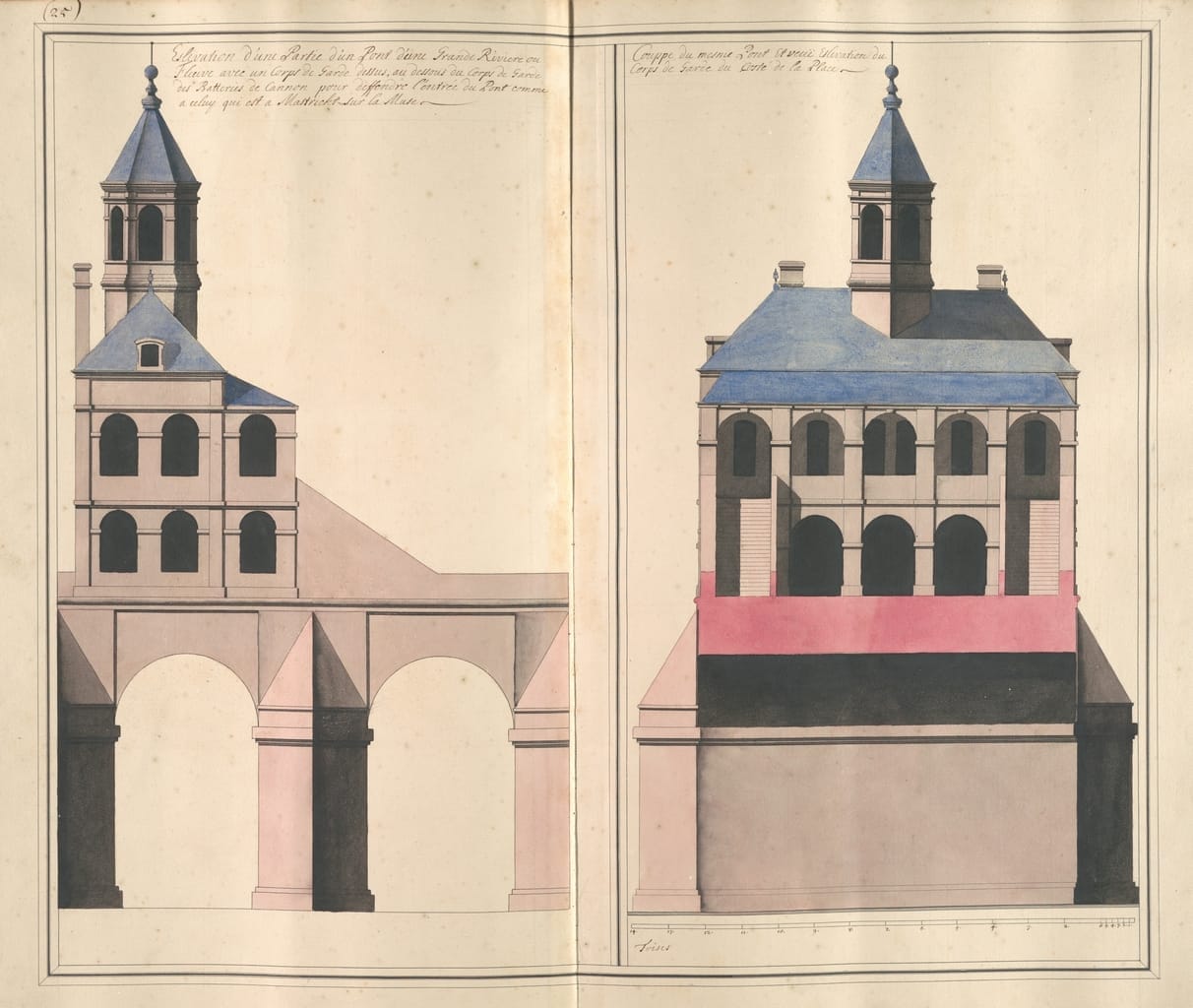
This Traité de l’architecture militaire was dedicated by Jacques Wibault to James, Duke of Ormond, and dated 25 May 1701. Consisting of over one hundred designs executed with refined skill and contained in a magnificent contemporary tooled morocco binding, the treatise fits into a well-established genre of fortification manuals. The drawings of carefully set out angled bastions and polygonal fortresses show that Wibault was fully au fait with the latest techniques in architectural draughtsmanship. They also demonstrate that he had considerable knowledge of contemporary fortification construction and had access to the latest designs of his French contemporaries. Among those whose works Wibault draws on is Sébastien Le Prestre, Marquis de Vauban (1633-1707), the greatest military engineer of the age who honed his expertise in defensive architecture during the forty-three sieges he himself conducted. Vauban’s final major work, the fortification at Neuf-Brisach (Neubreisach) in Alsace, was under construction while Wibault was working on the treatise and is illustrated in the volume. Wibault also included existing fortifications in Holland and the Spanish Netherlands, an area of Europe which had witnessed the most important technical developments in military engineering in the seventeenth century, while his own designs in the manuscript include projects for fortifications at Gosport and Portsmouth.

Wibault, who may have arrived in Ireland as a member of William III’s army, presumably hoped that the presentation of this treatise to Ormond would open a way towards a professional position in the Irish establishment. In this it would seem that he was disappointed. While he did secure some work under Surveyor General Thomas Burgh, he disappears from the records leaving only this magnificent volume as testament to his extraordinary professional competency.
Page form a treatise on military architecture presented by Jacques Wibault to James, Duke of Ormond, and dated 25 May 1701.

Military Planning

Andrew Tierney


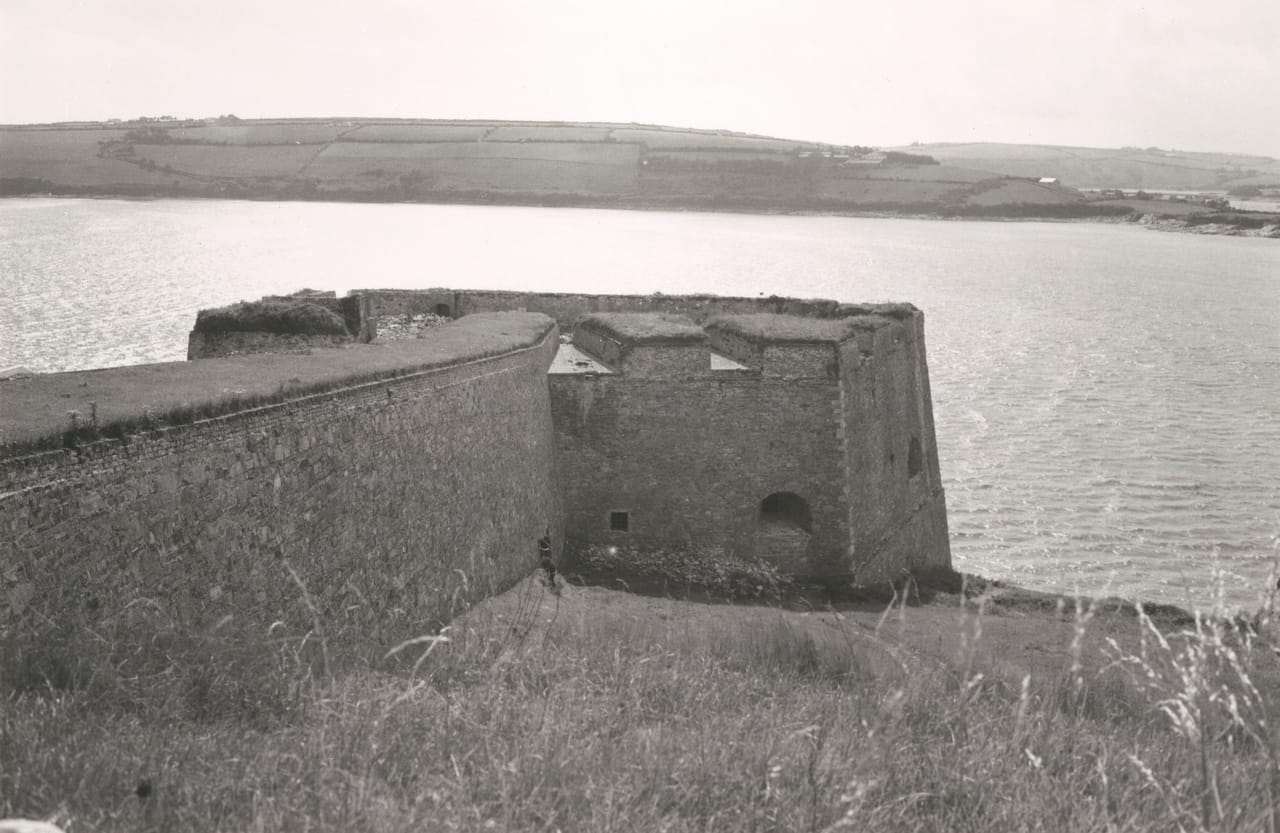
This extraordinary, unpublished volume of one hundred drawings by Jaques de Wibault, or more usually in the record Jacques Wibault, reflects a formative endeavour of early professional architectural practice in Ireland. As Renaissance learning spread north of the Alps during the sixteenth and seventeenth centuries, it did so amidst the turmoil of religious and dynastic war. With it came the intricate star-shaped bastions first devised by Italian engineers to resist canon fire and remove ‘les angles morts’. Techniques of siege and counter-siege dominated early modern warfare and transformed towns and forts across the continent. Paul Kerrigan’s Castles and Fortifications in Ireland, 1485-1945 (Cork, 1995) first showed the range of Renaissance fortifications in Ireland. Most are now destroyed, ruined or overgrown but their distinctive outlines can sometimes be appreciated from the air or in surviving plans. Forts at Maryborough (Portlaoise) and Philipstown (Daingean), built during the Marian plantation in the mid sixteenth century pre-date the arrival of such innovations, but new continental influences can be seen in towns and forts of the Munster and Ulster plantations, and the refortification of older English settlements. The best surviving examples are Elizabeth Fort in Cork city and Charles Fort commanding the entrance to the harbour at Kinsale (2.1), both of which are open to the public.


2.1 Devil’s Bastion, Charles Fort, Kinsale, Co. Cork (IAA Photo Collection 37/85 Z5)
Page form a treatise on military architecture presented by Jacques Wibault to James, Duke of Ormond, and dated 25 May 1701.
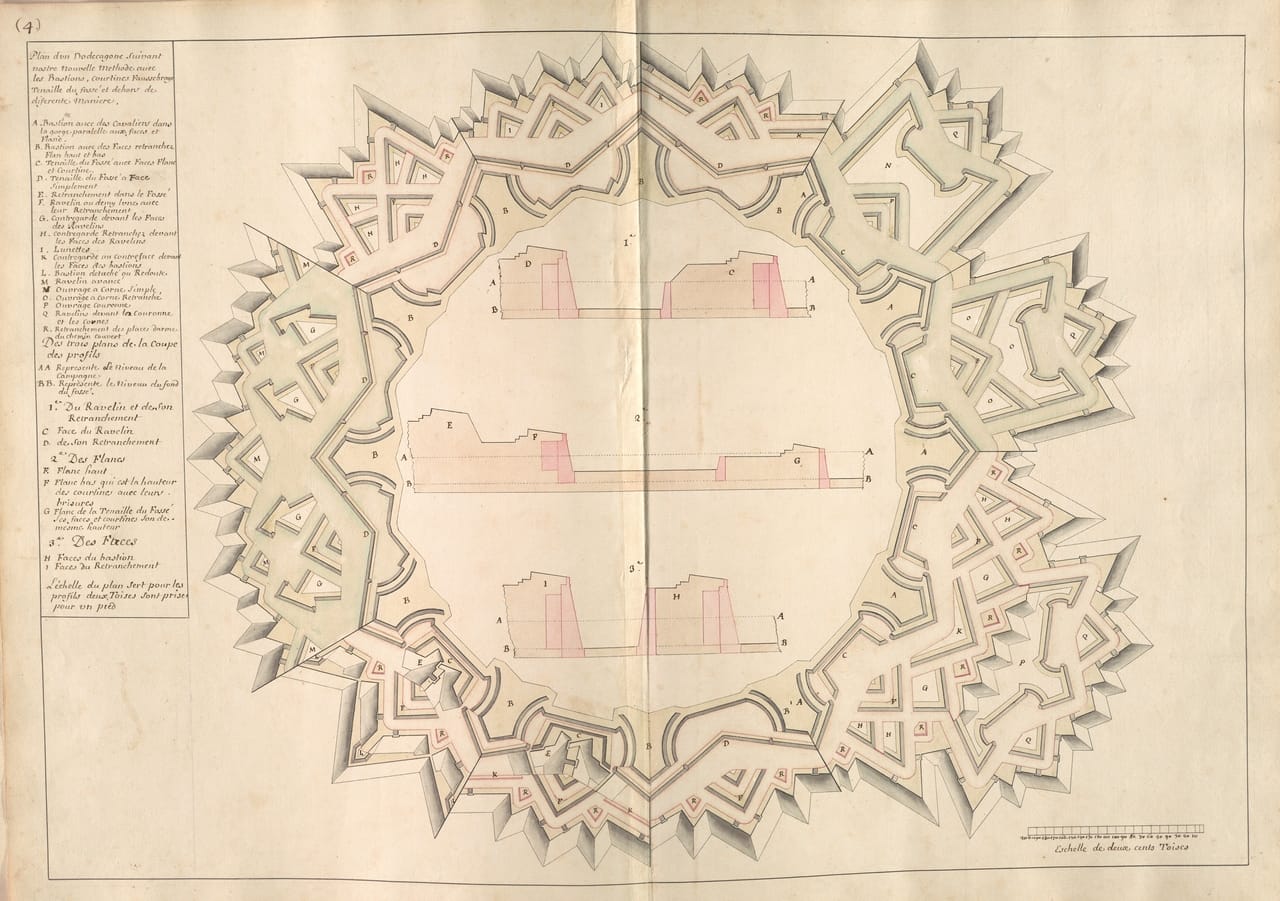
2.2 Jacques Wibault, ‘Plan dun Dodecagone suivant nostre nouvelle methode’ (IAA 77/9.93/4)

The most famous exponent of the ‘new method’, as it was known, was Louis XIV’s chief military engineer Sébastien Le Prestre, Marquis de Vauban (1633-1707), whose great bastioned forts underpin the designs in this extraordinary volume. The book forms part of a sudden flow of professional knowledge northwards after the revocation of the Edict of Nantes in 1685 forced the migration of many Huguenot engineers out of France.(1) While on the page such plans are idealised, Kerrigan noted that Vauban, who built an extraordinary series of forts on France’s borders, had stressed the need to adapt plans to their specific site, which often meant producing irregular plans in practice.(2) But Wibault clearly enjoyed the perfect geometry of these designs. At the start of his volume he sets out how the plan of each polygonal fort, from the quarré (square) to the dodecagone (twelve sided) might be calculated on the basis of the proportional relationship between two perpendicular lines. His scale, accompanying each drawing, and running from right to left, is the French toise – about six feet, or just under two metres. Each side might then be further fortified by additional independent ramparts, or ravelins, as required, creating the distinctively jagged outline. His most lavish creation, at the start of the volume (2.2), a dodecagon ‘following our new method’, is not a single design but an immensely complicated series of variations fused into one. That such designs emerge in the era of the fugue in music is hardly surprising for here surely is its visual corollary.

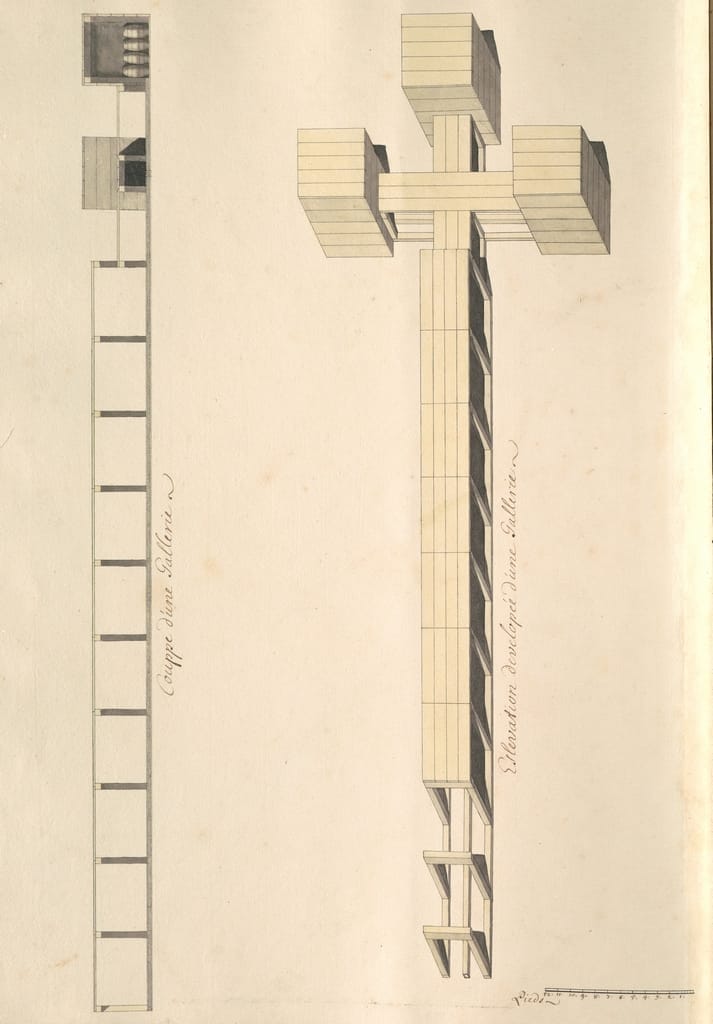
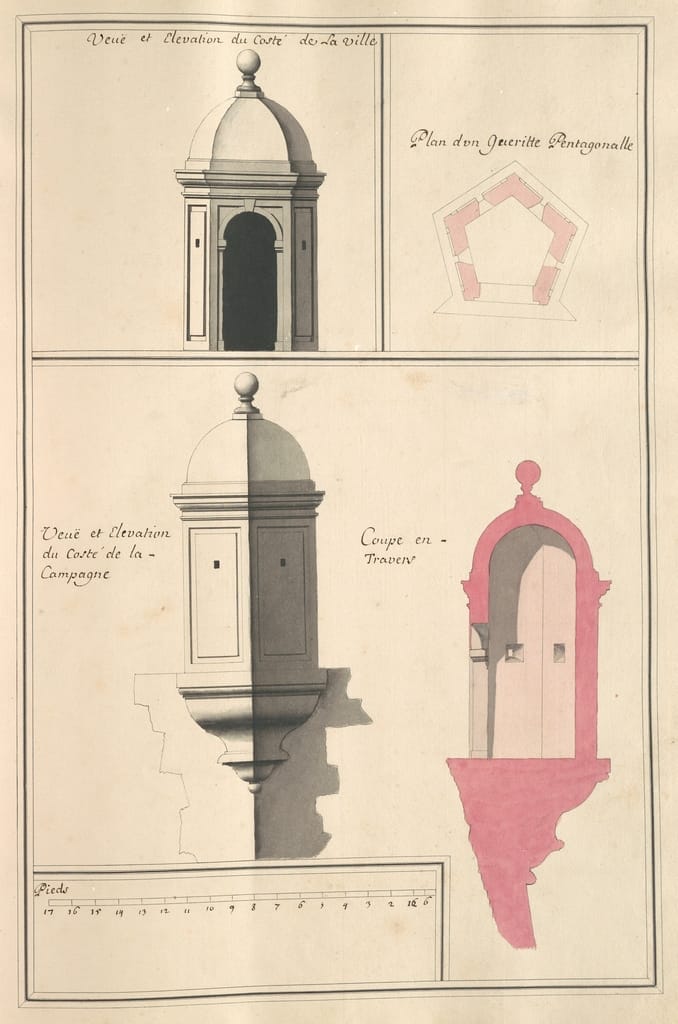
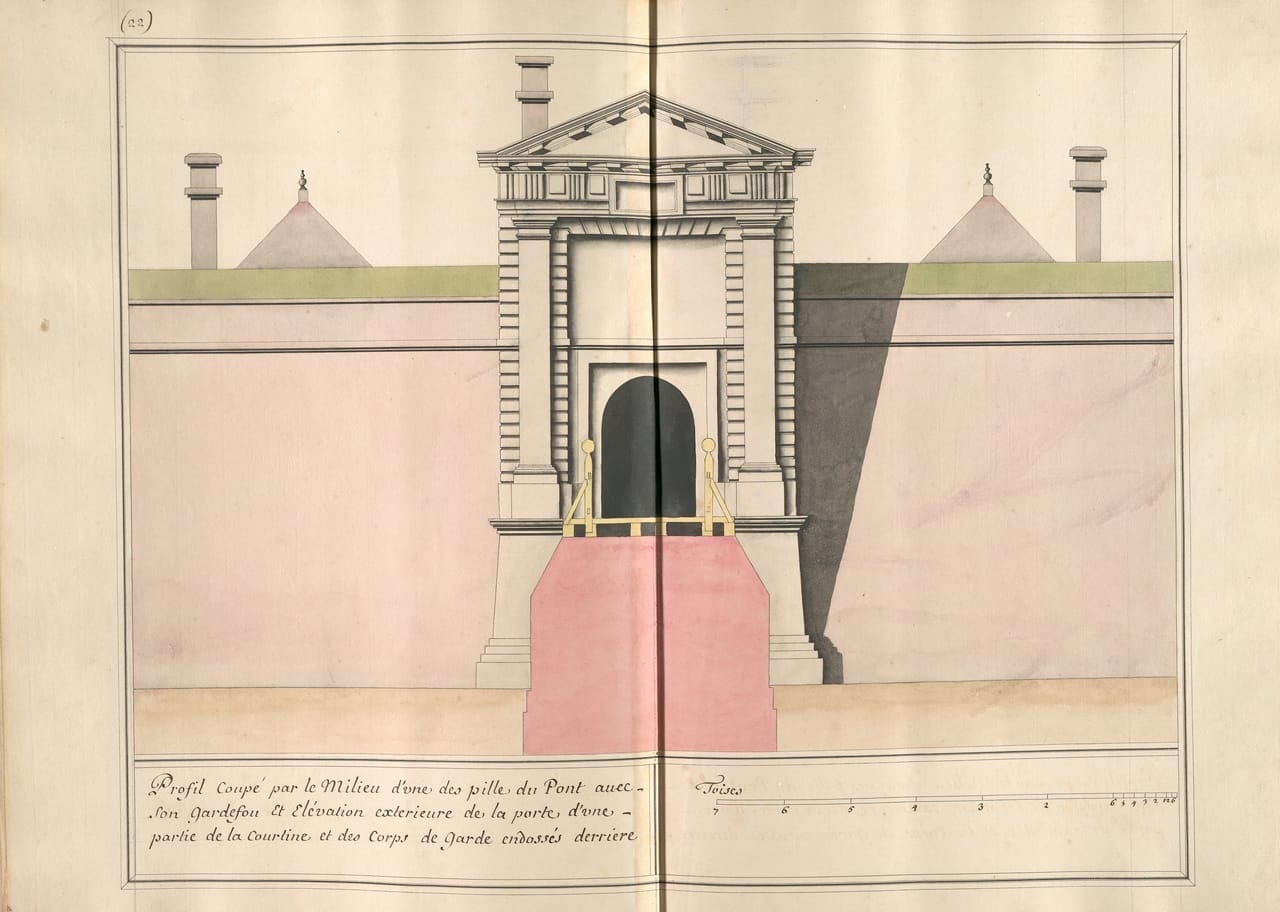
Ostentatious though these designs may be, what is most apparent is Wibault’s professional draughtsmanship: his manner of combining plans, elevations, sections and perspectives to configure his design as a technically and aesthetically legible whole. He has been trained to deploy colour in a taxonomic fashion to distinguish between different elements and points of view, drawing heavily on cartographic practice. Pink wash indicates the outline of a masonry or brick cross-section, a convention that would spread to French civil architecture during the first half of the eighteenth century but only finds its way to Britain after 1750;(3) orange for the cross-section of an earthwork; green, more mimetically, to show the grassy surface. Shading indicates the sloping embankments or glacis. Thus becomes clear what might otherwise be confusing sequences of parallel lines circuiting the inner line of defence. We also encounter the military engineer’s proficiency in isometric drawings and cross-sections – like those for his gallerie (2.3) where both form and construction are effectively demonstrated with line and shadow. More decorative are the pentagonal guerites or sentry boxes (2.4), shown in elevation, plan and section, with beautifully moulded corbelling, channelled masonry, and handsomely domed roofing topped with ball finials. An example very close in style to these can be found at Charles Fort, Kinsale. Another prominent architectural elaboration of such forts was the great rusticated gateway (2.5), reminiscent of the famous mid sixteenth-century exemplars by Sanmicheli at Verona in Italy and Zara in Dalmatia.

Page form a treatise on military architecture presented by Jacques Wibault to James, Duke of Ormond, and dated 25 May 1701.
2.3 Jacques Wibault, designs for a Gallerie (IAA 77/9.93/17)
Page form a treatise on military architecture presented by Jacques Wibault to James, Duke of Ormond, and dated 25 May 1701.
2.4 Jacques Wibault, Plan, section and elevations of a sentry box (IAA 77/9.93/30)
Page form a treatise on military architecture presented by Jacques Wibault to James, Duke of Ormond, and dated 25 May 1701.
2.5 Jacques Wibault, designs for a gateway (IAA 77/9.93/22)

Military engineering of this type, with its well-established graphic conventions and ornamental elaborations, is crucial to understanding the emergence of the architectural profession in a country like Ireland, which had limited civic and domestic investment before 1700. Rolf Loeber, in his survey of early modern practitioners in the country, showed that officer architects were particularly prevalent on this side of the Irish sea. Captain John Paine, Captain James Archer, Captain John Morton and Captain William Kenn were amongst the most prominent.(4) As Loeber notes, the chief architects of the late seventeenth and early eighteenth centuries, such as William Robinson and Thomas Burgh (both military men) held the formal title of ‘Surveyor-General of the Fortifications and Buildings’. It is unsurprising then that the first major public building in Dublin was William Robinson’s hospital at Kilmainham for retired soldiers (2.6), followed soon after by the great barracks built by his successor, Burgh, on the opposite side of the Liffey (now Collins Barracks). The great driving force of these architectural works were the Dukes of Ormond; it was to the second Duke, James Butler (1665-1745), that Wibault dedicated his book in 1701. It was not the only, or even the first, such book aimed at Ormond’s patronage. The first English translation of Vauban’s work, published in London in 1691 by Abel Swall, was dedicated to the young duke.(5) Swall, who had already published a London edition of François Blondel’s Nouvelle Manière de fortifier les places in 1684, was responding to ‘the general Complaint of the want of Books of Fortification in our English Tongue.’


Half Irish, half Dutch, the second Duke of Ormond was one of the most prominent military figures of the age and saw himself as a rival to the Duke of Marlborough. ‘War’, he wrote, ‘was my Sphere and every Thing else was insufferable to me.’(6) Already by the age of eighteen he was colonel of an Irish regiment of horse and at nineteen joined French forces at the siege of Luxembourg, one of the most important military engagements of the era, where Vauban was in command. He had at a young age what he himself described in his memoirs as ‘a martial Genius that was more than common in so tender a Youth.’(7) In 1690 he fought for William of Orange (his mother’s second cousin) at the Battle of the Boyne and remained one of the king’s closest confidants until his death. Having inherited debts of some £100,000 from his grandfather, his participation in military campaigns was a constant drain on his finances. But such was his value to the king that private acts of parliament were passed in 1695 and 1701 to protect his estates.(8) This latter year was that in which Wibault, who fought with him on campaign, dedicated his book to the Duke and it may well be due to his straitened finances that the book never made it into print.

Photograph of the Royal Hospital, Kilmainham, Dublin.
2.6 Royal Hospital, Kilmainham, Dublin (IAA Photo Collection 5/18 X21)
Title page form a treatise on military architecture presented by Jacques Wibault to James, Duke of Ormond, and dated 25 May 1701.
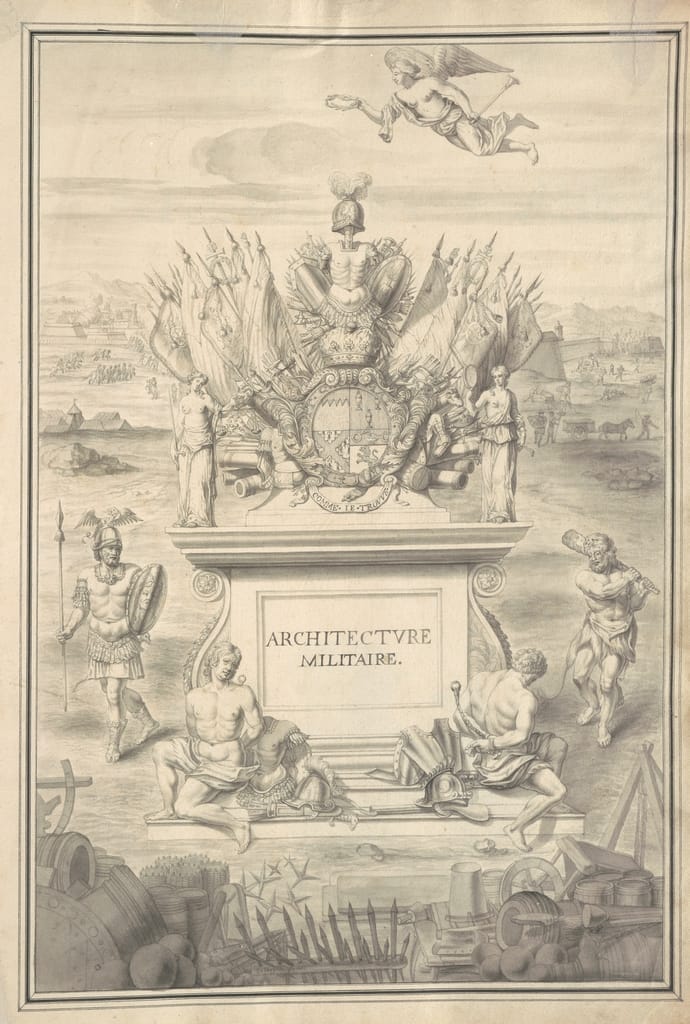
2.7 Frontispiece to Jacques Wibault, Traité de l’architecture militaire (IAA 77/9.93)

The volume’s elaborate frontispiece (2.7), a fusion of martial and classical motifs, provides some clue as to the intended production of the book. It includes the words La Vergne fecit on a cheval de frise in the foreground. This may well be the artist Paul La Vergne, who worked in partnership with the Flemish engraver Michael Van der Gucht (also Vandergucht), notable for contributing some of the engravings to Giacomo Leoni’s 1715 English translation of Palladio’s Quattro Libri.(9) Ironically, the rise of Palladianism came in tandem with the Hanoverian succession under the Whig supremacy that would force the Duke of Ormond into permanent exile on a charge of high treason. This turn in fortune insured that Wibault’s book would never appear in print. Had it done, it would certainly have been one of the most lavish productions of its type.


The careers of Robinson and Burgh mixed domestic and civic works with military fortifications and barracks, but by the second quarter of the eighteenth century the newly established peace allowed the focus of such men to shift. Burgh’s successor as Surveyor General, Edward Lovett Pearce, though an army captain, is not known for any major military instalments. Likewise, Richard Castle, although reputedly once an officer in a regiment of engineers with expertise in hydraulics, was little involved in infrastructural projects, military or otherwise, beyond that of the Newry Navigation. Domestic and civic commissions abounded. Nevertheless, it is from this military and engineering background that classical architecture on a grand scale first emerges in Ireland.

Footnotes:

1 Michèle Virol, ‘Savoirs d’ingénieur acquis auprès de Vauban, savoirs prisés par les Anglais?’, Documents pour l’histoire des techniques, 19|2e semestre 2010 (put online 23 June 2011).

2 Paul Kerrigan, Castles and Fortifications in Ireland, 1485-1945 (Cork, 1995), 10.

3 Basile Baudez, Inessential Colors: Architecture on Paper in Early Modern Europe (Princeton, 2021), 8-10, 79-118; Bénédicte Gady, ‘Codes, conventions, circulations: drawings as an instrument of collaboration in the work of Nicolas Pineau’, Andrew Tierney and Melanie Hayes eds, Between Design and Making: architecture and craftsmanship 1630-1760 (London, 2024), 92.

4 Rolf Loeber, A biographical dictionary of architects in Ireland 1600-1720 (London, 1981), 4-5.

5 Sébastien Le Prestre de Vauban, The new method of fortification, as practised by Monsieur de Vauban, Engineer General of France with an explication of all terms appertaining to that art / made English (London, 1691).

6 James Butler, Memoirs of the life of the late Duke of Ormond. Written by himself (London, 1741),159.

7 Butler, Memoirs of the life of the late Duke of Ormond, 6.

8 For the key episodes of his life, see Stuart Handley, ‘Butler, James, second duke of Ormond (1665–1745)’, Dictionary of National Biography. (doi.org).

9 Lydia Hamlett, ‘Not just a Pretty Face: Women’s Heroic Experience in The Heroides, Book Illustration & Mural Painting in Britain, 1700–1720’, Women’s Writing 30:3 (2023), 226–57.


Dr Andrew Tierney is Postdoctoral Research Fellow, European Research Council Advanced Grant project, STONE-WORK, Trinity College Dublin. He is an architectural historian with a broad chronological interest in building and design history.


Donate

Large or small, every donation helps secure the future of the collection. We are truly grateful for your support.

Donate now

Donate

Large or small, every donation helps secure the future of the collection. We are truly grateful for your support.

Donate now

Follow us

  • Facebook
  • Instagram
  • Linkedin

Address

45 Merrion Sq.
Dublin 2
D02 VY60

Contact

01 663 3040
info@irisharchitecturalarchive.ie

English | As Gaeilge

  • English

Opening Hours

Reading Room

10am-5pm, Tuesdays to Fridays; Mondays by appointment

Exhibitions

10am-5pm, Mondays to Fridays

Newsletter

Stay in touch, receive updates about exhibitions and events

Subscribe

English | As Gaeilge

Menu
  • Catalogue
  • Dictionary of Irish Architects
  • About Us
    • About
    • Board
    • Members
    • Staff
    • Annual Reports
    • Contact
  • Our Collections
    • Collections
    • Online Catalogue
  • Our Exhibitions
    • Current Exhibitions
    • Past Exhibitions
  • Our Building
    • No. 45 Merrion Square
    • Venue Hire
  • Access
    • Visit
    • Reading Room
  • Support us
    • Donate
    • Major Sponsors
Search this site

Subscribe

* indicates required

The Irish Architectural Archive will use the information you provide on this form to send you its regular Newsletter. Please confirm that you would like to hear from us:

You can change your mind at any time by clicking the unsubscribe link in the footer of any email you receive from us, or by contacting us at info@iarc.ie. We will treat your information with respect. By clicking below, you agree that we may process your information in accordance with these terms.

We use Mailchimp as our marketing platform. By clicking below to subscribe, you acknowledge that your information will be transferred to Mailchimp for processing. Learn more about Mailchimp's privacy practices.

  • English