

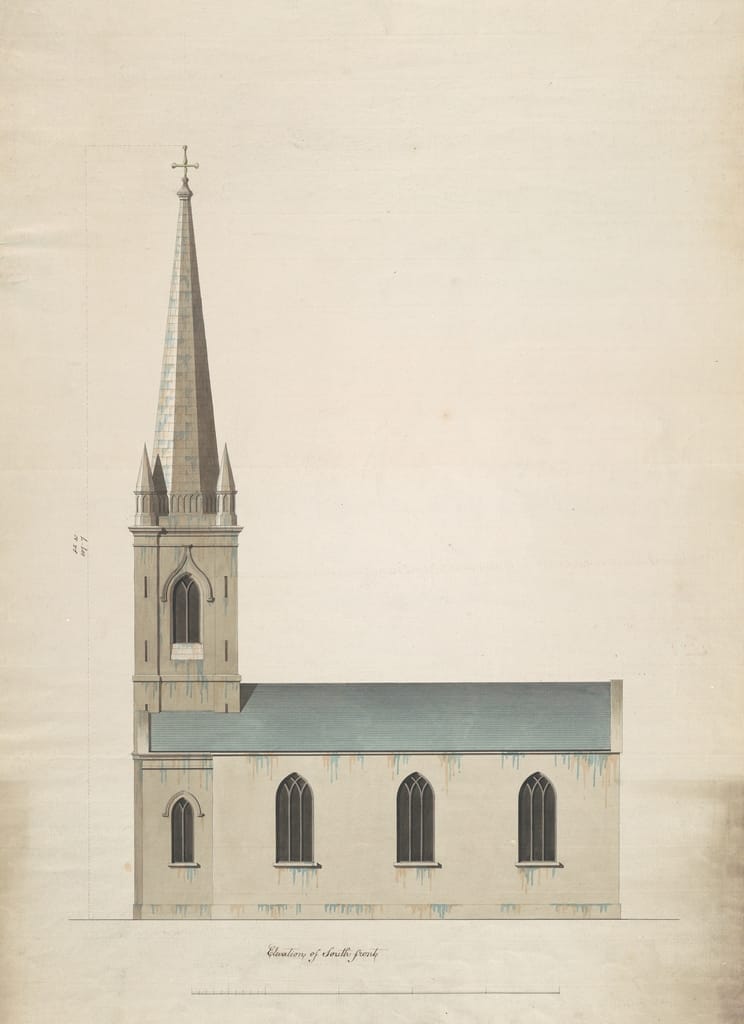
In a letter of 1820, the architect Francis Johnston referred to the fact that he had been employed between 1785 and 1794 on various architectural projects for Richard Robinson, 1st Baron Rokeby, who had become Archbishop of Armagh in 1765, including supervising the construction of Ballymakenny Church, Co. Louth. This led to speculation that Johnston had designed the church. Primarily on stylistic grounds however, this drawing – one of a set of four surviving for Ballymakenny Church – has been attributed to the architect Thomas Cooley. Born in London in 1742, Cooley won the Dublin Royal Exchange (now City Hall) architectural competition of 1768-9. This victory brought him to Ireland where he remained for the rest of his life. In 1775 Cooley succeeded Joseph Jarratt as Clerk and Inspector of Civil Buildings at the Barrack Board. He also had a number of influential private clients including Archbishop Robinson who employed him as his architect in building projects in the city and diocese of Armagh. It was Robinson who sent Francis Johnston to work in Cooley’s office circa 1778. Johnston remained with Cooley until the latter’s death and succeeded him as the Archbishop’s architect. It seems therefore that Cooley designed Ballymakenny Church and that Johnston supervised its erection after Cooley’s death.
This client’s drawing, and the others in the set, depict Ballymakenny Church as built. It shows a tower, topped by a steeple, located at the west end of the building and contained the main entrance. Behind the tower is the body of the church, a narrow hall lit by three pointed-arch windows with Y-tracery. This hall-and-tower type would become the near-default design approach adopted by the architects of the Board of First Fruits and its successor from 1834, the Ecclesiastical Commissioners, for new churches in their decades long post-Union programme of Government-funded building, repairing and enlarging of the churches and glebe houses of the Established Church throughout Ireland.


