Skip to content
  • Catalogue
  • Dictionary of Irish Architects
  • Catalogue
  • Dictionary of Irish Architects
Menu

Menu

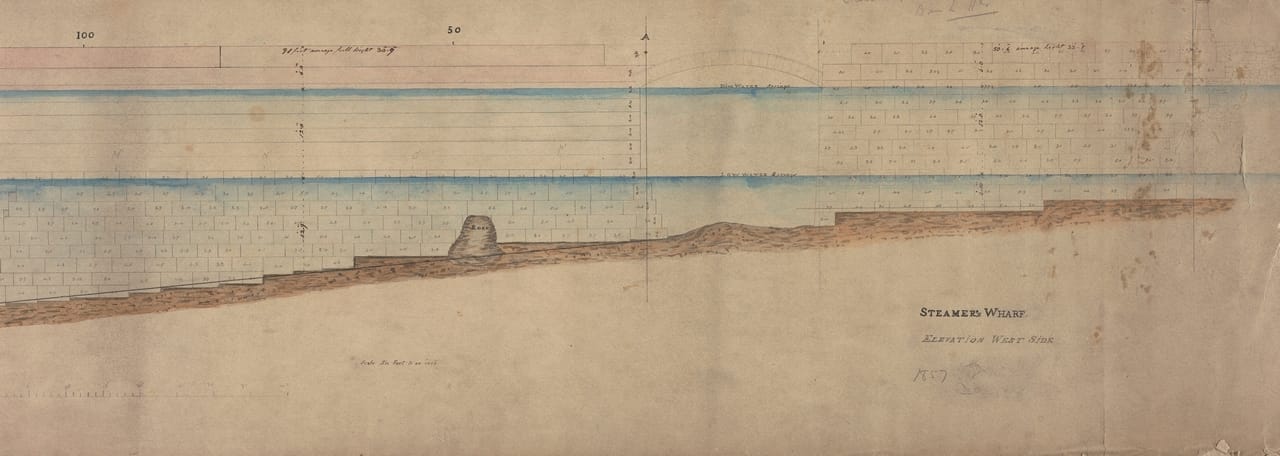
Steamer’s Wharf Elevation West Side

Barry D. Gibbons

1853-57

IAA Carlisle Pier Drawings Collection 2022/26.2

Building for Transport III: Harbours

Steamer’s Wharf Elevation West Side

Barry D. Gibbons

1853-57

IAA Carlisle Pier Drawings Collection 2022/26.2

The first stone of the East Pier of the Royal Asylum Harbour of Kingstown, or Dun Laoghaire Harbour as it is now, was laid on 31 May 1817. The East and West Piers were well on their way to completion by 1826 when the Admiralty transferred mail packet sailings from Howth to Kingstown. The following year a timber structure was built off the East Pier to provide a dedicated mail packet wharf. This proved unsatisfactory but the completion of Victoria Wharf (now St Michael’s Wharf) in 1837 improved the situation somewhat. The London to Holyhead railway was completed in 1848. This lead to an increase in both passenger numbers and mail which meant larger ships working the Holyhead to Kingstown route, which in turn lead to demands for a bigger and better wharf.

The contract for a new steamer wharf was signed on 21 April 1852. It was designed by Barry Duncan Gibbons, Resident Engineer for Kingstown Harbour from 1838 until his death in 1862. This drawing records progress on the construction of the steamer wharf up to the Summer of 1857, by which time it had reached a length of just over 667 feet. The wharf became operational in 1859.

As well as being the Harbour Engineer, Gibbons had also secured the post of Resident Engineer to the Dublin and Kingstown Railway. As such, he was perfectly placed to ensure that the railway ran onto his new wharf to meet the steamers, an innovation much praised at the time for its great convenience. It is possibly for this reason that, although officially named after George William Frederick Howard, seventh Earl of Carlisle, Lord Lieutenant when construction was completed, the wharf was for many years known as Gibbons’ Pier.

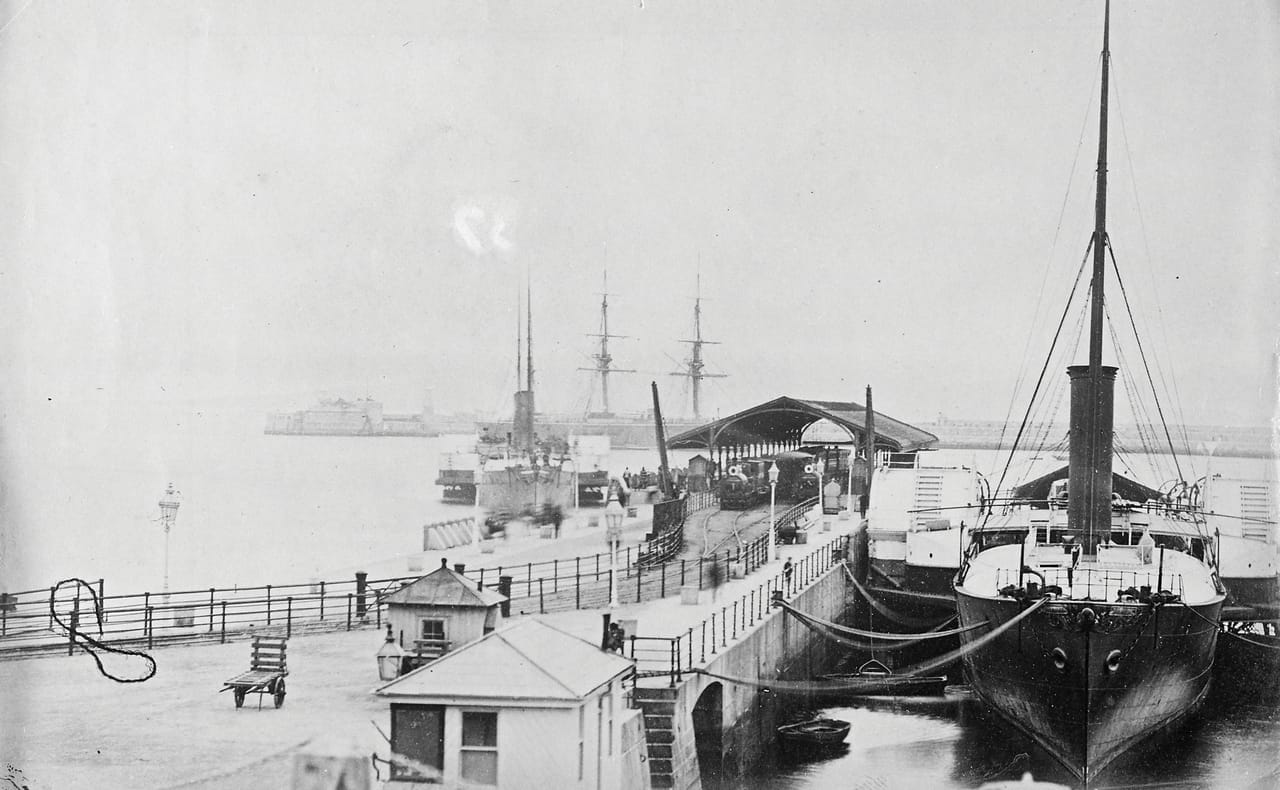
Black and white photograph taken in about 1890 showing ships moored at the Carlisle Pier in what was then called Kingston Harbour, and is now Dun Laoghaire Harbour. The photograph is from the Clarke Photographic Collection in the National Library of Ireland.
11.1 Ships moored at Kingston Harbour, W. M. Lawrence & Co. el al photographer, c, 1890 (Clarke Photographic Collection, National Library of Ireland)

The New Steamship Wharf in Dun Laoghaire Harbour

Elizabeth Shotton

The steam power that launched the railway age also transformed sea travel as ships powered by steam, or even a combination of steam and sail as at the beginning, proved to be quicker and more reliable than traditional ships under sail. For the mail service in particular this reliability and speed, in contrast to the calms and headwinds that could bedevil mails carried by sail,(1) proved critical: the Post Office began experimenting with steam packets in 1821 for mail between Ireland and Britain and by 1823 steam became ‘the predominant means of travel’.(2) In 1824 the journey by steam between Dublin and Liverpool took a mere fourteen hours,(3) in comparison to what was usually a three-to-four day journey by sail.(4) Surpassing the speed of sail crossing the North Atlantic took longer to accomplish. The steamship Savannah made the crossing in twenty-nine days in 1819, a time sailing ships could beat given favourable conditions.(5) However, by 1839 steam could reliably outrun sail, halving the time on westward trips and reducing the time by a third on the eastward sailings.(6)

It is within this context that the Steamer’s Wharf, more commonly known as Carlisle Pier, was constructed in the 1850s, being the third in a series of landing places for steam ships built in harbour at Dun Laoghaire. The harbour itself was originally designed as a refuge for ships in times of storm, and the sloping faces of its piers were unable to facilitate the mooring of ships. The need for a landing place became imperative when the mail service to Britain, originally operated from Howth Harbour, was moved to Dun Laoghaire in 1826. The first landing site was a timber wharf built off the East Pier in 1827.(7) This ultimately proved to be dangerous for ships to approach ‘in gales from the north and west, which are most prevalent and severe’.(8) By 1833, construction had begun on what would become Victoria Wharf (now St Michael’s Wharf) running parallel to the shoreline just west of where Carlisle Pier would be located.(9) Victoria Wharf was intended also to serve as the terminus to the first railway built in Ireland, the Dublin and Kingstown Railway.(10) A contemporaneous description from 1834, the year the rail service first started and two years before it was extended to the new Victoria Wharf prophesised that ‘... when the works are completed, passengers may step from the Railway coaches to the steamers, and again, on arriving will, with the mail bags, be conveyed from the Royal Harbour of George the Fourth to the centre of the Irish metropolis.’(11) This ambition would only be fully realised with the building of the third landing site, the Steamer Wharf (11.1).

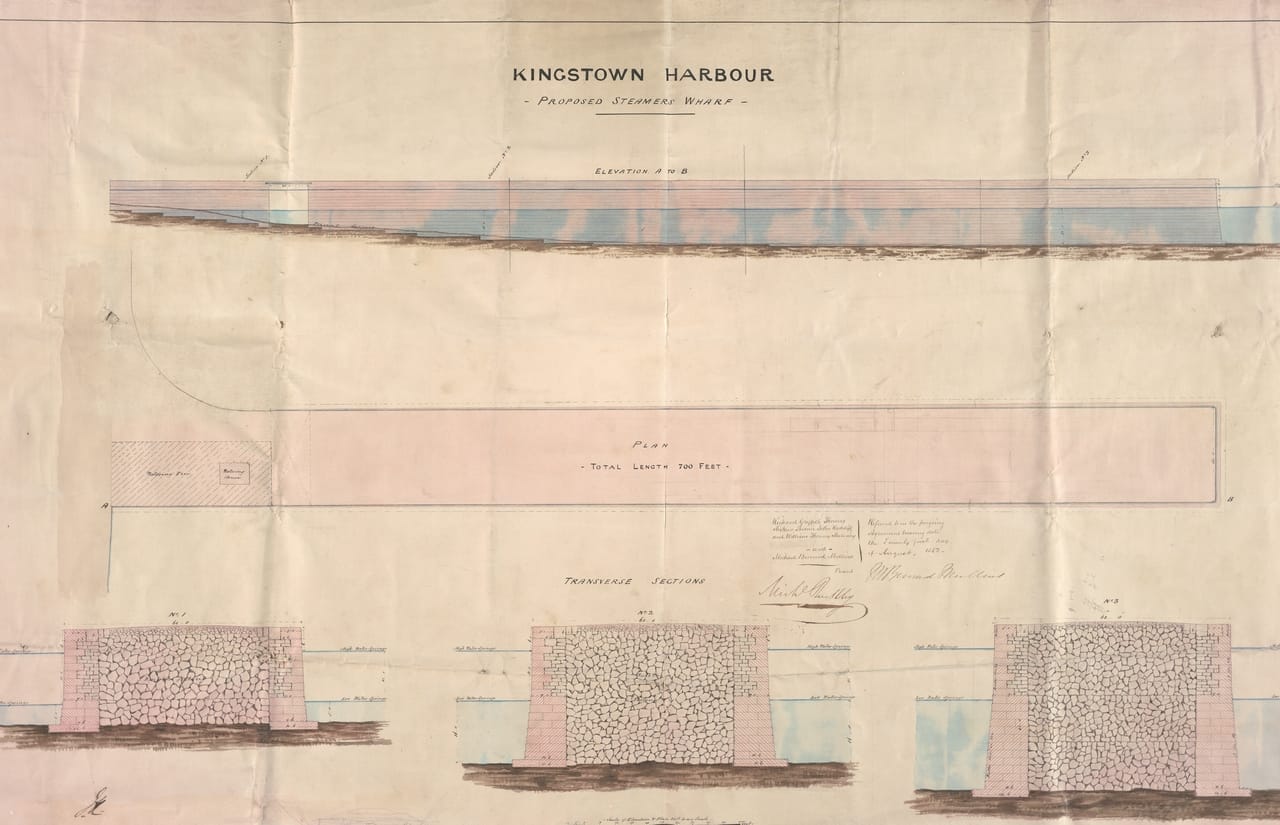
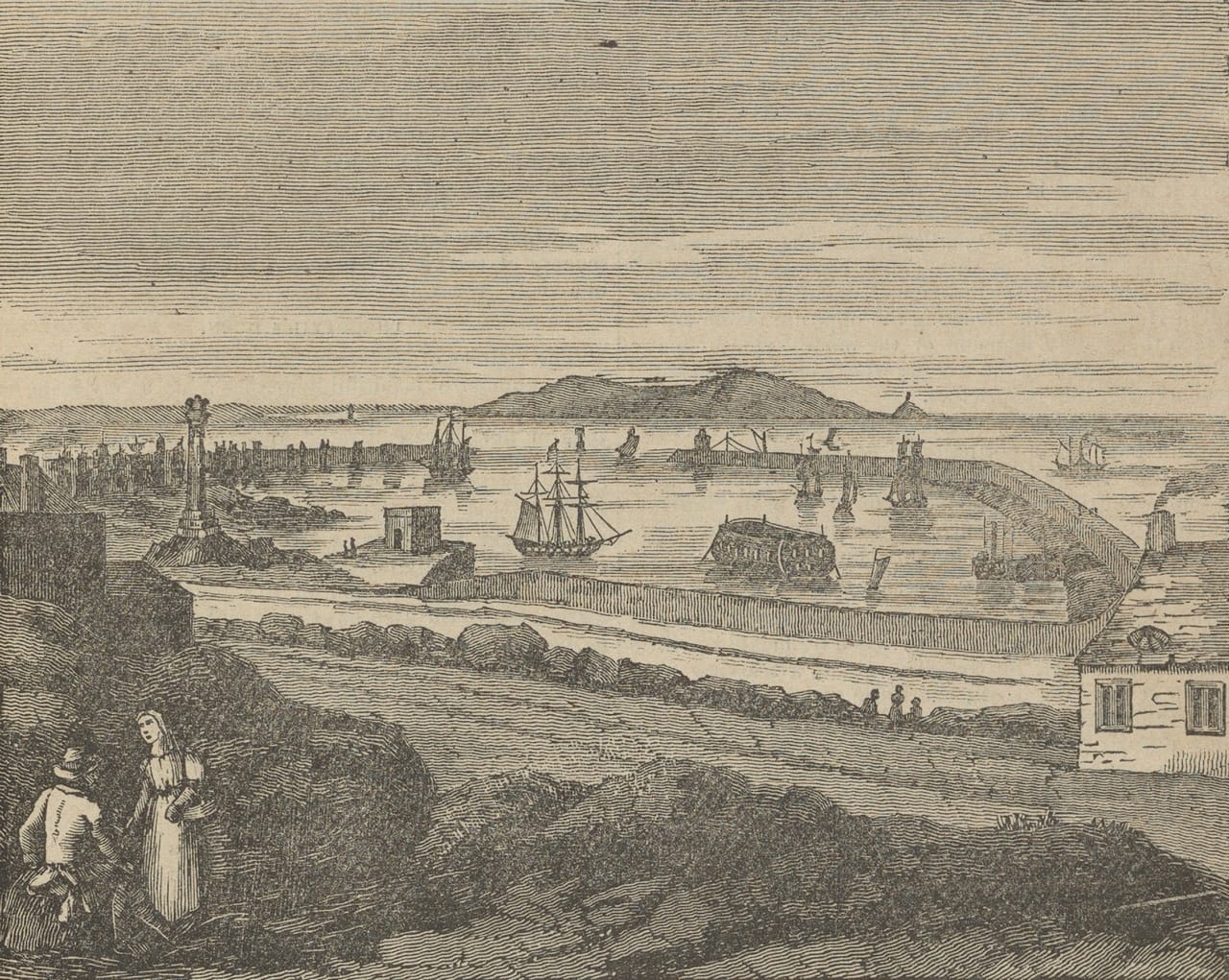
By January 1846 Barry D. Gibbons (1792-1862), Resident Engineer to the Kingstown Harbour from 1838 to 1862, had submitted a proposal to the Board of Public Works for both a new Traders Wharf for commercial vessels in the west of the harbour and a new Steamers Wharf.(12) This latter was deemed necessary as landings at Victoria Wharf had proved difficult for steamers during easterly gales.(13) Though approved in principle by the Board of Public Works, by the UK Treasury who would ultimately fund the works, and by the UK Admiralty who retained rights of refusal for construction along coasts, construction was deferred until works on the East Pier were completed. A contract was eventually signed on 24 July 1852 with Michael Bernard Mullins, eldest son of Bernard Mullins of the noted firm of building contractors Messrs Henry, Mullins & McMahon, just as the partnership was completing work on the Traders Wharf. A careful study of the contract drawing (11.2) reveals that the new pier was built on an older structure commonly referred to as the watering pier, which was recorded in a view of the Dublin and Kingstown Railway published in the Dublin Penny Journal in 1834 (11.3).

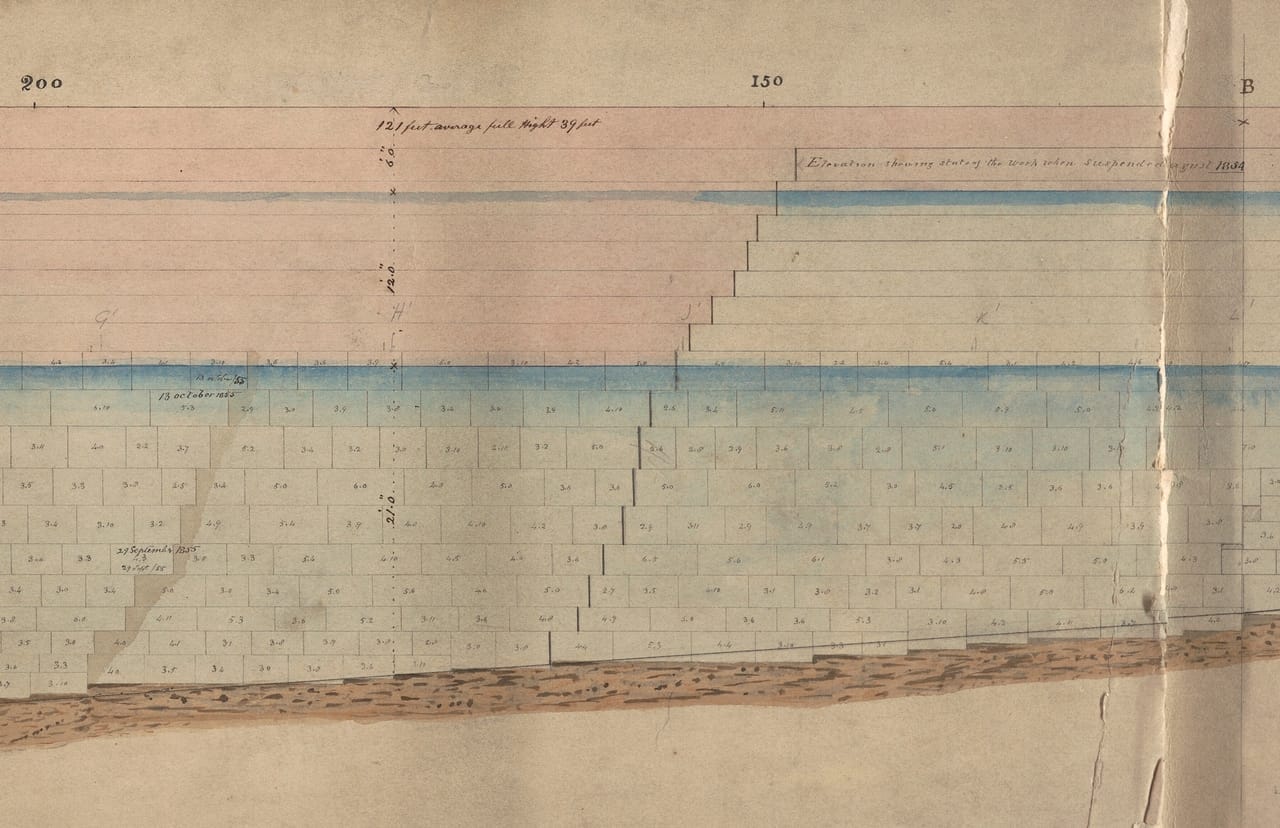
The progress drawing of the pier records the block-by-block building effort which began in 1853. It is an example of a document type that Gibbons seems to have introduced to the Board of Public Works, a more schematic variety of which he requested from district engineers and clerks on other harbour projects. By the 1880s this system of recording work done had been replaced by colour-coded plans and sections indicating progress on a weekly or bi-weekly basis. In the case of Kingstown, as Gibbons had an office on site, he could afford to make a single generous sized progress drawing to track work on the new steamer wharf.

Contract architectural drawing for the building of a new steamers wharf in Kingstown Harbour, signed on 21 August 1852.
11.2 Kingstown Harbour, Proposed Steamers Wharf, contract drawing, signed 21 August 1852 (IAA Carlisle Pier Drawings Collection 2022/26.1)
Engraving entitled ‘Kingstown Pier’ from the Dublin Penny Journal of 25 January 1834.
11.3 ‘Kingstown Pier’, Dublin Penny Journal, No. 82, Vol. II, 25 January 1834, 233 (IAA C.DUB.1.0)
Deatail form an architectural drawing of the west side of the steamer’s wharf to be built in Dun Laoghaire Harbour.
11.4 Steamer’s Wharf Elevation West Side (IAA Carlisle Pier Drawings Collection 2022/26.2). Detail

Close examination of the drawing reveals a note at the 150 foot mark: ‘Elevation showing state of the work when suspended August 1854’ (11.4). The disruption to the work may be attributed to one of the Commissioners of Public Works in Ireland, Richard Griffith C.E. (1784-1878). While he was in London in May of 1853, Griffith asked the well-known British engineer James Meadow Rendel (1799-1856), then president to the Institution of Civil Engineers, to come to Ireland to give an opinion on the position of the pier.(14) Rendel was the consulting engineer for the steam packet station at Holyhead in Wales, to which the mails from Kingstown were then being directed, and Griffith may have considered that the works should be coordinated. Rendel, following a site visit in June 1853, submitted a report in August that proposed an angled pier extending eastward off Victoria Wharf for larger craft.(15) While Gibbons accepted that the wharf, which had originally been designed in 1845 for steamers 250 feet long, should be lengthened to 800 feet to accommodate current steamers 300-400 feet in length, he otherwise rejected Rendel’s proposal.(16) In this he was backed by the Board of Works which agreed to lengthen the wharf at their November 1853 meeting.(17) In the summer of 1854 the UK Treasury requested that Rendel address Gibbons’ comments on his earlier proposal. This is when building work was halted. Rendel’s second report, which he only submitted in April 1855, in effect proposed the reinstatement of the original wharf on the East Pier,(18) a plan which Gibbons easily dissuaded the Board of Works from adopting given the difficulties already encountered with this strategy.(19) Work on Gibbon’s lengthened wharf finally recommenced in September 1855, and the wharf had reached a length of 667 feet 7 inches by the Summer of 1857 when space on the progress drawing page ran out. It became operational in 1859.

What is not evident in the progress drawing but alluded to in Gibbons’ correspondence with the contractor, as well as raised in later published works, is that Carlisle Pier may be the first marine project in Ireland to make use of Portland cement-based concrete in its foundations. Nearly twenty years after the construction of the Carlisle Pier, James Barton, C.E. (1826-1913), when discussing the use of concrete blocks and concrete in bags in the railway quay just completed at Greenore, Co. Louth, noted that Gibbons had described that he used concrete in bags as a foundation course for levelling upon the rock for the Carlisle Pier.(20) Though no direct mention of concrete is found in the files currently available for Carlisle Pier in the National Archives, there are tantalising clues to its use in the copy letter books recording the contract negotiations in 1852. In a series of exchanges regarding the appropriate piece rate for stonework, Gibbons agreed that this should be higher than for the Traders Wharf given ‘the difficulty of securing the pile toes on the rocky bottom… and preparing the foundations in Rock’.(21) The conversation continued with Gibbons reassuring Mullins that a clause in the specifications stating that ‘the bed is to be… cleared away until a solid compact and level foundation is attained’ was not meant to imply that ‘the rock in situ should be cut away until an equal even plane is obtained for the whole thickness, but that the projections of the rock should be cut off until a solid bed was attained for the footing course upon which it would set level’.(22) A footing course that would ‘set level’ corresponds not with stone but with what could be expected of bags of concrete laid down on the bedrock which would ’settle’ in a level fashion.

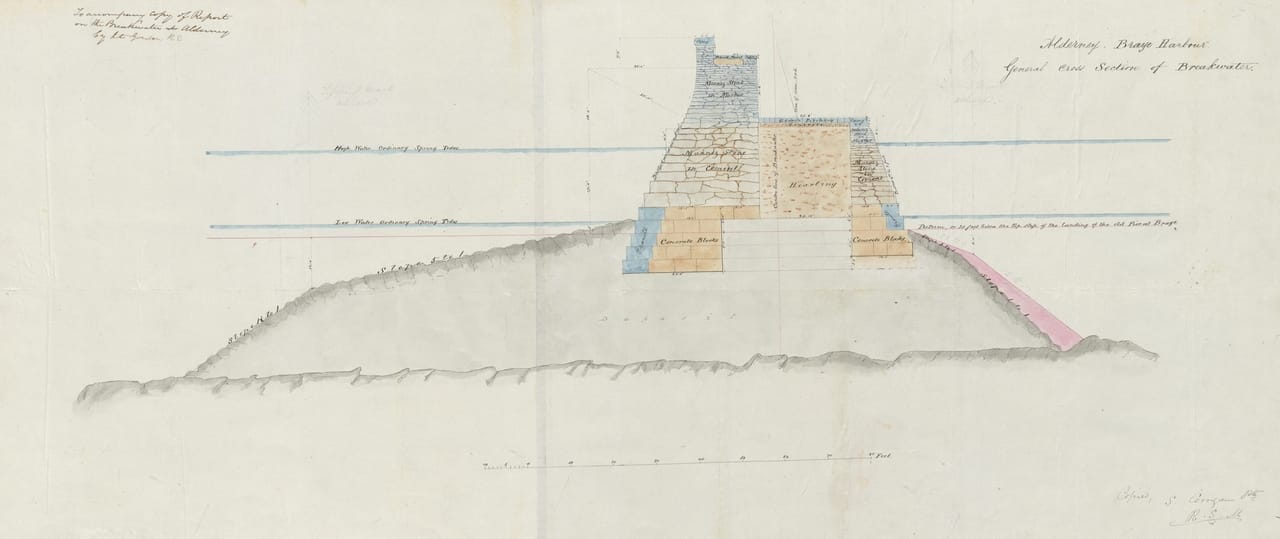
Although the French had been exploring the use of cementitious materials in marine constructions for some time, using pozzolana in the Algiers breakwater in the 1830s and hydraulic lime a decade later in Marseille,(23) it was the British who experimented with Portland cement-based concrete beginning with precast foundation blocks used in the Alderney Breakwater in 1853 (11.5). Thus, the use of Portland cement-based concrete in coastal sea works in the 1850s was at an experimental stage not only in Ireland but in the UK more generally. Gibbons went on to use Portland cement in other marine projects,(24) and the drainage engineers with the Board had also used it in the foundations of a River Glyde bridge in 1850.(25) But it took nearly two decades until the next significant use of concrete in maritime structures in Ireland: the work of Barton at Greenore; in the foundations of Coliemore harbour by Bindon Blood Stoney, C. E. (1828–1909) in 1869;(26) and finally Stoney’s more substantive precast concrete blocks used for the North Quay extension in Dublin Port started in 1871.(27) It was not until the mid-1870s, when the Board of Public Works in Ireland finally adopted the use of concrete in their marine works more generally, that the material became commonly used. This makes Carlisle Pier pivotal not only for linking Ireland’s first railway directly to steam ships, but for the introduction of Portland cement-based concrete to marine works in Ireland.


Architectural drawing showing the general cross section of the breakwater at Braye Harbour, Alderney. THe drawing was copied by Private S. Corrigan of the Royal Sappers and Miners in 1853. The original is in the UK National Archives, Kew, London.
11.6 Alderney, Braye Harbour, General Cross Section of Breakwater, copied by Private S. Corrigan, Royal Sappers and Miners, 1853 (National Archives, UK, MFQ 1/1298/24)

Footnotes

1 D. B. Tyler, Steam Conquers the Atlantic (New York, 1972), 126.

2Tyler, Steam, 18.

3Tyler, Steam, 29.

4 M. J. Tutty, ‘The City of Dublin Steam Packet Company’, Dublin Historical Record, 18, 3 (1963), 80.

5 Tyler, Steam, 8-12, 128.

6 Tyler, Steam, 128.

7 Dun Laoghaire Harbour Company, The Construction of Dun Laoghaire Harbour (Dublin, 2003), 17.

8 Instructions from Board of Works to Mr. Rendel in 1853, to report on Packet Pier in course of execution in Kingstown Harbour, and Mr. Rendel’s Report relating to Improvement of Kingstown Harbour, 18; H.C. 1854-55 (476), xlvii, 522.

9 Dun Laoghaire Harbour Company, Construction, 18.

10 John Montague and John P. Clancy, ‘Railways’ in ‘Infrastructure’, Andrew Carpenter et al. eds Art and Architecture of Ireland Volume IV: Architecture 1600-2000 (Dublin, 2015), 159.

11 Thirteen Views on the Dublin and Kingstown Railway (Dublin, 1834), 15.

12 Copy letter from Barry D. Gibbons to Chairman, Board of Public Works, 22 July 1854 (National Archives of Ireland (NAI), Office of Public Works, Engineers Letter Book, 1848 to 1855, OPW/1/8/3/1 413).

13 Copy Letter from Barry D. Gibbons to Board of Public Works regarding Timber Jetty at East Pier, 24 Sept 1847 (NAI, Office of Public Works, Piers & Harbours Letter Book, 8 May 1846-27 June 1848, OPW/1/8/1/1, 243).

14 Copy Letter from Richard Griffith writing from London to J. M. Rendall [sic] CE 26 May 1853 (NAI, Office of Public Works, Piers and Harbours Letter Book, 16 August 1851-6 March 1854, OPW/1/8/2/4, 290).

15 Instructions from Board of Works, 4-5 and Plan A. See also Copy Report of J. M. Rendel to Mr Griffth, Commissioner, Board of Public Works, August 1853 (NAI, Office of Public Works, Engineers Letter Book, 1848 to 1855, OPW/1/8/3/1, 399).

16 Instructions from Board of Works, 5-8. Also see Copy Report of B. D. Gibbons to Mr Griffth, Commissioner, Board of Public Works, September 1853 (NAI, Office of Public Works, Engineers Letter Book, 1848 to 1855, OPW/1/8/3/1, 404).

17 Instructions from Board of Works, 9.

18 Instructions from Board of Works, 13.

19 Copy Report of B. D. Gibbons to Mr Hornsby, Secretary to the Board of Public Works, April 1855 (NAI, Office of Public Works, Engineers Letter Book, 1848 to 1855, OPW/1/8/3/1, 414).

20 James Barton, ‘Carlingford Lough and Greenore (Including Plates)’, Minutes of the Proceedings of the Institution of Civil Engineers, xliv, no. 1435 (1876), 139.

21 Copy Letter of B. D. Gibbons to the Board of Public Works, 5 August 1852 (NAI, Office of Public Works, Engineers Letter Book, 1848 to 1855, OPW/1/8/3/1, 374-75).

22 Copy Letter of B. D. Gibbons to Michael Bernard Mullins, 21 August 1852 (NAI, Office of Public Works, Engineers Letter Book, 1848 to 1855, OPW/1/8/3/1, 376).

23 John Rennie, C.E., The Theory, Formation, and Construction of British and Foreign Harbours, Vol. 2 (London, 1854), 267, 295.

24 Copy Letter from Edward Hornsby to Wm Campbell, Kilmore regarding cement for works at Slade Pier 30 Mar 1854 (NAI, Office of Public Works, Piers and Harbours Letter Book, 16 August 1851 – 6 March 1854, OPW/1/8/2/4, 14) and Copy Letter from Edward Hornsby to Thos Neill, Newcastle for bill for cement on Newcastle Pier, 14 Mar 1856 (NAI, Office of Public Works, Piers and Harbours Letter Book, 16 August 1851-6 March 1854, OPW/1/8/2/4, 387).

25  Robert Manning, ‘Presidential Address to Institution of Civil Engineers of Ireland’, Transactions of the Institution of Civil Engineers of Ireland, 12 (1878), 77.

26 William Spratt-Murphy, ‘Coliemore Harbour: A Historical Study of the Minor Harbours of the South-East Coast of Ireland’ (M.Arch. dissertation, University College Dublin, 2015), 15. See also J. J. Gaskins, Irish Varieties (Dublin, 1869), 7.

27 B. B. Stoney, ‘On the Construction of Harbour and Marine Works with Artificial Blocks of Large Size. (Includes Plates and Appendix)’, Minutes of the Proceedings of the Institution of Civil Engineers xxxviii, no. 1376 (1874), 333.


Professor Elizabeth Shotton is Professor in the School of Architecture, Planning and Environmental Policy, University College Dublin. She teaches construction technology and design studio, with an emphasis on sustainable building and development.

Donate

Donate now

Donate

Donate now

Follow us

  • Facebook
  • Instagram
  • Linkedin

Address

45 Merrion Sq.
Dublin 2
D02 VY60

Contact

01 663 3040
info@irisharchitecturalarchive.ie

English | As Gaeilge

  • English

Opening Hours

Reading Room

10am-5pm, Tuesdays to Fridays; Mondays by appointment

Exhibitions

10am-5pm, Mondays to Fridays

Newsletter

Stay in touch, receive updates about exhibitions and events

Subscribe

English | As Gaeilge

Menu
  • Catalogue
  • Dictionary of Irish Architects
  • About Us
    • About
    • Board
    • Members
    • Staff
    • Annual Reports
    • Contact
  • Our Collections
    • Collections
    • Online Catalogue
  • Our Exhibitions
    • Current Exhibitions
    • Past Exhibitions
  • Our Building
    • No. 45 Merrion Square
    • Venue Hire
  • Access
    • Visit
    • Reading Room
  • Support us
    • Donate
    • Major Sponsors
Search this site

Subscribe

* indicates required

The Irish Architectural Archive will use the information you provide on this form to send you its regular Newsletter. Please confirm that you would like to hear from us:

You can change your mind at any time by clicking the unsubscribe link in the footer of any email you receive from us, or by contacting us at info@iarc.ie. We will treat your information with respect. By clicking below, you agree that we may process your information in accordance with these terms.

We use Mailchimp as our marketing platform. By clicking below to subscribe, you acknowledge that your information will be transferred to Mailchimp for processing. Learn more about Mailchimp's privacy practices.

  • English