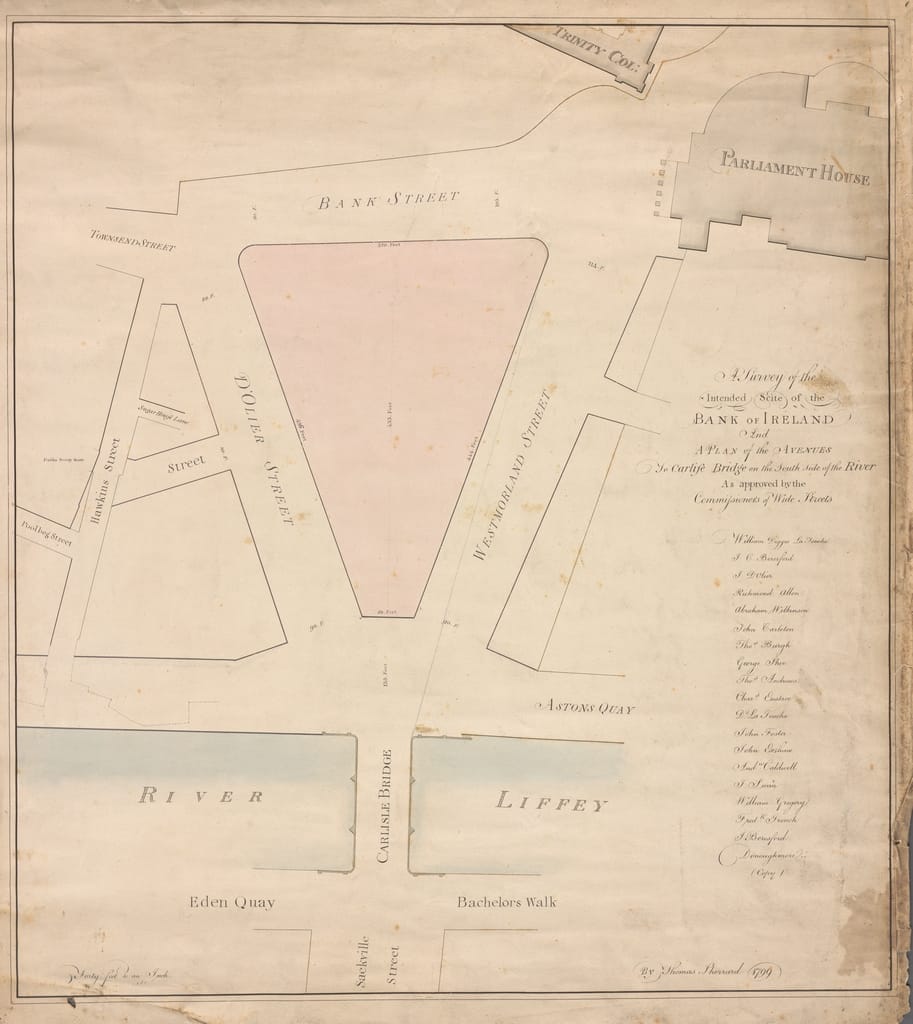
Footnotes:
1 Discussions about this proposal and their agreements took place at various times in 1799, but at no single meeting were all of the undersigned present. See for example Dublin City Library and Archive WSC/Mins/15, 263–73, 6 & 11 July 1799.
2 John Montague, ‘From Rome to Paris and London: searching for the European roots of the Wide Streets Commissioners’, Irish Architectural and Decorative Studies XXI (2018), 52–73; Niall McCullough ed., A vision of the city: Dublin and the Wide Streets Commissioners (Dublin, 1991); Edward McParland, ‘Strategy in the planning of Dublin, 1750-1800’, P. Butel and L. M. Cullen eds, Cities and merchants: French and Irish perspectives on urban development, 1500-1900 (Dublin, 1986), 97–107; Murray Fraser, ‘Public building and colonial policy in Dublin, 1760-1800’, Architectural History 28 (1985), 102–23; Edward McParland, ‘The Wide Streets Commissioners, their importance for Dublin architecture in the late 18th–early 19th century’, Irish Georgian Society Quarterly Bulletin 15 (1972), 1–32.
3 Dublin City Library and Archive, WSC/Mins/4, 52: 23 March 1782; WSC/Mins/43, 293 & 296: 15 February 1837; WSC/Mins/50, 109: 2 January 1851.
4 Dublin City Library and Archive, WSC/Maps/362. See for example the report from Andrew Caldwell for the Committee on the alignment of D’Olier Street with the future Great Brunswick Street, Dublin City Library and Archive WSC/Mins/18, 1–2: 27 May 1802.
5 See Dublin City Library and Archive, WSC/Maps/57; and another Wide Streets drawing, now untraced but reproduced in T. K. Whitaker, ‘Origins and Consolidation, 1783–1826’, F. S. L. Lyons ed., Bicentenary essays, Bank of Ireland 1738–1983 (Dublin, 1983), 11–29, at 13.
6 Edward McParland, ‘The bank and the visual arts’, F.S.L. Lyons ed., Bicentenary essays, Bank of Ireland 1738–1983, (Dublin, 1983), 96–139, at 99, plates 35 & 36. Dublin City Library and Archive, WSC/Maps/515/1–2.
7 Dublin City Library and Archive, WSC/Mins/15, 261: 4 July 1799.
8 Before this, as McParland ‘The bank and the visual arts’, 97–98, notes, the bank had turned for earlier schemes to Samuel Sproule in the 1780s, and other lesser lights of the architectural scene, while ignoring figures such as James Gandon, Thomas Cooley and Thomas Ivory, who might have provided a little more architectural ambition.
9 John Summerson, ‘The evolution of Soane’s bank stock office at the Bank of England’ Architectural History 27 (1984), 135–49; Dorothy Stroud, Sir John Soane, architect (London, 1996), 62–63, 151–68. Soane had remodelled Lord Abercorn’s Baronscourt, Co. Tyrone, from 1791. See, Stroud, 150–51, & pls 101–102. The work was carried out by Soane’s assistant Robert Woodgate, who later established a practice in Ireland. The Soane work in Baronscourt was greatly altered in the 1830s by William Vitruvius Morrison.
10 See for example, Soane Museum 71/4/2–3 and 16/7/9.
11 McParland, ‘The bank and the visual arts’, 101–103.
Dr John Montague is Associate Professor in the College of Architecture, Art and Design, at the American University of Sharjah in the United Arab Emirates. He is currently preparing a book on the history of the Wide Streets Commissioners.