Skip to content
  • Catalogue
  • Dictionary of Irish Architects
  • Catalogue
  • Dictionary of Irish Architects
Menu

Menu

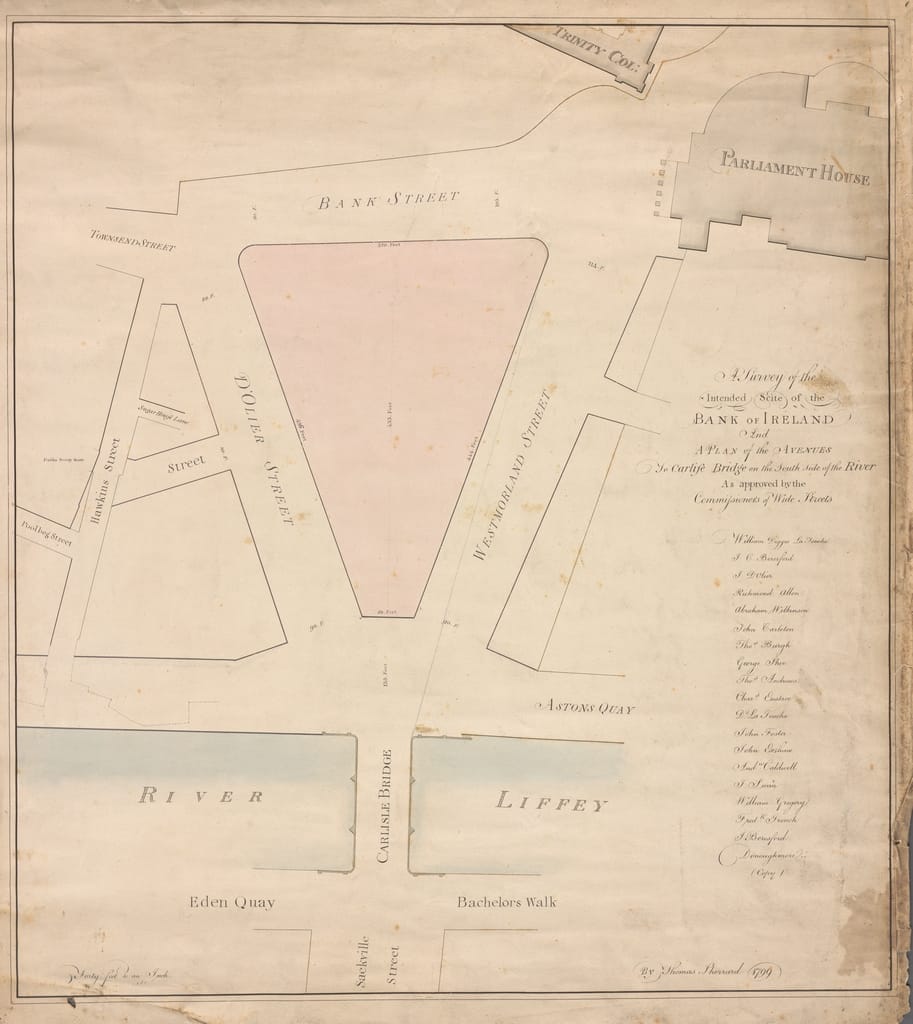
A Survey of the Intended Scite of the Bank of Ireland

Thomas Sherrard

1799

Ink and colour wash on paper

IAA Bank of Ireland Drawings Collection 2006/65

6. Urban Planning II: Wide Streets

A Survey of the Intended Scite of the Bank of Ireland

Thomas Sherrard

1799

Ink and colour wash on paper

IAA Bank of Ireland Drawings Collection 2006/65

The Dublin Wide Streets Commission, effectively the first planning authority in Ireland, and one of the earliest anywhere, was established in 1758 with the mandate to widen and modernise the streets of the medieval city of Dublin.

From the late 1770s Thomas Sherrard was employed by the Commission as a surveyor, and in 1789 he was appointed to the salaried post of clerk/secretary and surveyor to the Commission. Among the many surviving schemes proposed by Sherrard, his plans for widening Trinity Lane and College Green were approved by the Commissioners in February 1785, for Conyngham Road in 1786, and for Westmoreland Street in 1793. In recognition of his work Sherrard Streets Upper and Lower were named for him when they were laid out in 1828.

Oriented with south at the top, this particular plan by Sherrard is focused on the triangular site created by D’Olier Street, Westmoreland Street and what is now College Street. Sherrard has named it Bank Street, as this was to be the location for the entrance front to the new headquarters for the Bank of Ireland, a building which would occupy the entire triangular plot. Detailed plans for the proposed bank were drawn up by the English architect Sir John Soane who had already designed the Bank of England in London on a similarly shaped site. However, the Dublin scheme was abandoned following the Act of Union of 1800. Instead, the Bank of Ireland acquired the newly redundant Parliament House in 1803 and converted this into its headquarters. It remains there to this day.

A survey or plan of the proposed site for a new Bank of IRweland building in Dublin by Thoams Sherrard, 1799. Thomas Sherrard 1799

The Wide Streets Commission

John Montague

‘A Survey of the Intended Scite of the Bank of Ireland And A Plan of the Avenues To Carlisle Bridge on the south side of the River as approved by the Commissioners of Wide Streets’ is a tidy pen-and-ink plan with light watercolour washes, made by Thomas Sherrard in 1799 as a presentation drawing from the Wide Streets Commissioners to the Bank of Ireland. The list of nineteen signatories under the title on the right is designated by Sherrard, in brackets, as a ‘Copy’ and is in fact a copperplate record rather than the Commissioners’ original signatures, which he would have gathered on another drawing, now lost, from the Commissioners’ own archives.(1) The sheet presents an unrealised planning proposal at the eastern heart of the expanding eighteenth-century city, marking the deliberate shift of Dublin’s urban axis eastwards from its earlier core. It carries the new line south from the formerly self-contained Gardiner’s Mall to the river, across James Gandon’s Carlisle Bridge, and into two newly proposed avenues that bifurcate around a triangular block, shaded here in light pink, intended for the Bank of Ireland’s new premises. Westmoreland Street established an important processional and visual axis to Gandon’s recently completed portico of the House of Lords on the east side of the Parliament House. D’Olier Street, meanwhile, gave access for the time being only to Townsend Street, since Great Brunswick Street (later Pearse Street) was not yet laid out; when that new thoroughfare was formed, it extended the vista from the House of Lords portico eastwards, beyond the newly confined northern boundary of Trinity College, following an axis that projected ultimately towards Ringsend. This single sheet connects several intertwined histories: nearly half a century of the Commissioners’ city planning, its careful execution and management by their surveyor and secretary Thomas Sherrard, the Bank of Ireland’s search for a new home, and the unrealised designs for a new bank prepared by John Soane, architect to the Bank of England.

Established in 1758, the Wide Streets Commissioners were among the earliest urban planning authorities in Europe and the first of their kind in these islands.(2) Their influence was transformative, replacing Dublin’s congested medieval network with a coherent pattern of broad, straight avenues that connected the city’s political, commercial and residential centres, in ways attuned to the realities of its eastern expansion. Their method drew upon continental theories of urban rationalism, tempered by a sustained administrative pragmatism. Nevertheless, along the newly widened streets they paid close attention to architectural effect: a unity of façade design and scale produced continuous street envelopes whose regularity gave visual coherence to the new urban order. Not all of it was successfully realised, and in turn, the extent of changes to individual façades in the centuries since has diminished our understanding of the original coherence and spatial ambition of their work.

Sherrard’s influence on all of this was especially important. Appointed in 1782, he remained active until just days before his death in 1837; his duties were then continued by his son and co-administrator, David Henry Sherrard, until the project finally drew to a close in early 1851.(3) Sherrard moved easily between survey, planning and architecture, producing working drawings, elevations and legal maps with equal assurance. Although figures such as James Gandon and Francis Johnston tend to dominate accounts of the period, Sherrard was an equally formative presence, ensuring that the Commissioners’ intentions were precisely translated into the urban fabric. His duties extended far beyond the drawing board: he prepared valuations, negotiated with property owners, supervised demolitions and coordinated the complex exchanges of title that underpinned every widening and new street. His drawings define the visual identity of the Commissioners’ archive: rigorous in line, sparing in ornament and unfailingly clear in notation.

Because the drawing for the bank was a presentation drawing, it lacks the palimpsest quality often found in other Wide Streets sheets, where new proposals are superscribed over surveys of existing buildings which were still largely intact and not yet cleared. A useful comparison is the surviving Wide Streets drawing No. 362,(4) in which bold red lines outlining options for the new avenues overscore the lighter pinks and greys of existing houses, warehouses, sugar refineries, and related industries, including Mr Sweetman’s brewery, which at that time blocked further access along the river at what would later become Burgh Quay (6.1).

A projected Wide Streets Commissioners plan of Westmoreland and D'Olier Streets, Dublin from about 1790. The original is in the Dublin City Library and Archive.
6.1 Projected plan of Westmoreland and D'Olier Streets, c. 1790 (Dublin City Library and Archive, WSC/Maps/362/1)

Notable differences between Sherrard’s presentation drawing and what was eventually realised include the proposed connection between D’Olier Street and Hawkins Street, although a narrower laneway further north would later be opened in its place. Conversely, the present-day continuation of Fleet Street across Westmoreland Street to D’Olier Street was not included in this plan, as the intention was to preserve an uninterrupted site for the bank. The just visible corner of Trinity College, rendered in light grey wash at the top of the map, looks west towards the old city, while the new portico of the Parliament House – the destination of the newly formed axis from Gandon’s bridge – faces east towards the new.

The Bank of Ireland, founded under a 1781 act of parliament, established itself in premises at the corner of Boot Lane and St Mary’s Abbey to the rear of Capel Street in 1783.(5) By the turn of the century, this was already a less fashionable and increasingly neglected quarter of the city. In 1796, the Commissioners, encouraged by the Lord Lieutenant, explored for the bank two alternative schemes for refashioning the site of the old Custom House at Wellington Quay.(6) Even these, however, would have stood apart from the newly forming fashionable axis extending south from the north side of the city towards College Green. With this in mind, the entire island between the new avenues of Westmoreland and D’Olier Streets was offered to the bank, and an agreement was concluded with Jeremiah D’Olier – then governor of the bank and himself a Wide Streets Commissioner – for a rent of £1,200 a year and a lease down payment of £10,780 (6.2 and 6.3).(7)

A Wide Streets Commissioners plan of streets around St Mary’s Abbey and Boot Lane, Dublin. The original is in the Dublin City Library and Archive.
6.2 Plan of streets around St Mary’s Abbey and Boot Lane, (Dublin City Library and Archive, WSC/Maps/57)
A Wide Streets Commissioners survey drawing for the proposed site for the National Bank in Dublin. The original is in the Dublin City Library and Archive.
6.3 ‘A Survey of Ground Proposed for a Scite for the National Bank Dublin’ (Dublin City Library and Archive, WSC/Maps/515/1)

John Soane – already architect of the Bank of England in London and later celebrated for the extraordinary house-museum he created at Lincoln’s Inn Fields – was commissioned by the Bank of Ireland to design new premises on the Commissioners’ triangular site.(8) At the London bank, Soane had transformed an unwieldy accumulation of offices and courtyards into a sequence of intricately lit, interlocking volumes: domed banking halls, top- and side-lit corridors, and shallow segmental vaults in which light and structure were subtly interwoven. It was the most sophisticated experiment in spatial atmosphere then underway in Europe, and it established Soane’s reputation.(9)

A considerable body of drawings by Soane survives from his brief engagement with the Dublin project, including plans, elevations and perspectives, most of them exploring the extended frontage intended for Bank Street (eventually College Street) and dating from around 1799 to 1800.(10) Political events soon rendered them obsolete. The Act of Union of 1800 dissolved the Irish Parliament and left Edward Lovett Pearce’s great building on College Green vacant from the beginning of the following year. The Bank of Ireland seized the opportunity and acquired it for £40,000 – roughly four times what the Commissioners’ triangular site would have cost, but a sum that included the substantial value of the now-disused parliament building itself. Although Henry Aaron Baker, partner to James Gandon, was initially declared the successful candidate in the competition for its remodelling, the commission ultimately fell to Francis Johnston.(11) His reorganisation of the interior spaces, together with his discreet doubling of the east side to mirror Edward Parke’s colonnaded quadrant on the west, transformed the former Parliament House into one of the most remarkable bank buildings anywhere – the unplanned outcome of political circumstance in which an ambitious new project gave way to a brilliant act of architectural adaptation (6.4).

A perspective view of proposed Bank of Ireland, Dublin, by Sir John Soane from 1799. The original is in the Sir John Soane Museum, London.
6.4 Perspective view of proposed Bank of Ireland, Dublin, John Soane, 1799 (Sir John Soane Museum 16/7/9)

Footnotes:


1 Discussions about this proposal and their agreements took place at various times in 1799, but at no single meeting were all of the undersigned present. See for example Dublin City Library and Archive WSC/Mins/15, 263–73, 6 & 11 July 1799.

2 John Montague, ‘From Rome to Paris and London: searching for the European roots of the Wide Streets Commissioners’, Irish Architectural and Decorative Studies XXI (2018), 52–73; Niall McCullough ed., A vision of the city: Dublin and the Wide Streets Commissioners (Dublin, 1991); Edward McParland, ‘Strategy in the planning of Dublin, 1750-1800’, P. Butel and L. M. Cullen eds, Cities and merchants: French and Irish perspectives on urban development, 1500-1900 (Dublin, 1986), 97–107; Murray Fraser, ‘Public building and colonial policy in Dublin, 1760-1800’, Architectural History 28 (1985), 102–23; Edward McParland, ‘The Wide Streets Commissioners, their importance for Dublin architecture in the late 18th–early 19th century’, Irish Georgian Society Quarterly Bulletin 15 (1972), 1–32.

3 Dublin City Library and Archive, WSC/Mins/4, 52: 23 March 1782; WSC/Mins/43, 293 & 296: 15 February 1837; WSC/Mins/50, 109: 2 January 1851.

4 Dublin City Library and Archive, WSC/Maps/362. See for example the report from Andrew Caldwell for the Committee on the alignment of D’Olier Street with the future Great Brunswick Street, Dublin City Library and Archive WSC/Mins/18, 1–2: 27 May 1802.

5 See Dublin City Library and Archive, WSC/Maps/57; and another Wide Streets drawing, now untraced but reproduced in T. K. Whitaker, ‘Origins and Consolidation, 1783–1826’, F. S. L. Lyons ed., Bicentenary essays, Bank of Ireland 1738–1983 (Dublin, 1983), 11–29, at 13.

6 Edward McParland, ‘The bank and the visual arts’, F.S.L. Lyons ed., Bicentenary essays, Bank of Ireland 1738–1983, (Dublin, 1983), 96–139, at 99, plates 35 & 36. Dublin City Library and Archive, WSC/Maps/515/1–2.

7 Dublin City Library and Archive, WSC/Mins/15, 261: 4 July 1799.

8 Before this, as McParland ‘The bank and the visual arts’, 97–98, notes, the bank had turned for earlier schemes to Samuel Sproule in the 1780s, and other lesser lights of the architectural scene, while ignoring figures such as James Gandon, Thomas Cooley and Thomas Ivory, who might have provided a little more architectural ambition.

9 John Summerson, ‘The evolution of Soane’s bank stock office at the Bank of England’ Architectural History 27 (1984), 135–49; Dorothy Stroud, Sir John Soane, architect (London, 1996), 62–63, 151–68. Soane had remodelled Lord Abercorn’s Baronscourt, Co. Tyrone, from 1791. See, Stroud, 150–51, & pls 101–102. The work was carried out by Soane’s assistant Robert Woodgate, who later established a practice in Ireland. The Soane work in Baronscourt was greatly altered in the 1830s by William Vitruvius Morrison.

10 See for example, Soane Museum 71/4/2–3 and 16/7/9.

11 McParland, ‘The bank and the visual arts’, 101–103.


Dr John Montague is Associate Professor in the College of Architecture, Art and Design, at the American University of Sharjah in the United Arab Emirates. He is currently preparing a book on the history of the Wide Streets Commissioners.


Donate

Large or small, every donation helps secure the future of the collection. We are truly grateful for your support.

Donate now

Donate

Large or small, every donation helps secure the future of the collection. We are truly grateful for your support.

Donate now

Follow us

  • Facebook
  • Instagram
  • Linkedin

Address

45 Merrion Sq.
Dublin 2
D02 VY60

Contact

01 663 3040
info@irisharchitecturalarchive.ie

English | As Gaeilge

  • English

Opening Hours

Reading Room

10am-5pm, Tuesdays to Fridays; Mondays by appointment

Exhibitions

10am-5pm, Mondays to Fridays

Newsletter

Stay in touch, receive updates about exhibitions and events

Subscribe

English | As Gaeilge

Menu
  • Catalogue
  • Dictionary of Irish Architects
  • About Us
    • About
    • Board
    • Members
    • Staff
    • Annual Reports
    • Contact
  • Our Collections
    • Collections
    • Online Catalogue
  • Our Exhibitions
    • Current Exhibitions
    • Past Exhibitions
  • Our Building
    • No. 45 Merrion Square
    • Venue Hire
  • Access
    • Visit
    • Reading Room
  • Support us
    • Donate
    • Major Sponsors
Search this site

Subscribe

* indicates required

The Irish Architectural Archive will use the information you provide on this form to send you its regular Newsletter. Please confirm that you would like to hear from us:

You can change your mind at any time by clicking the unsubscribe link in the footer of any email you receive from us, or by contacting us at info@iarc.ie. We will treat your information with respect. By clicking below, you agree that we may process your information in accordance with these terms.

We use Mailchimp as our marketing platform. By clicking below to subscribe, you acknowledge that your information will be transferred to Mailchimp for processing. Learn more about Mailchimp's privacy practices.

  • English