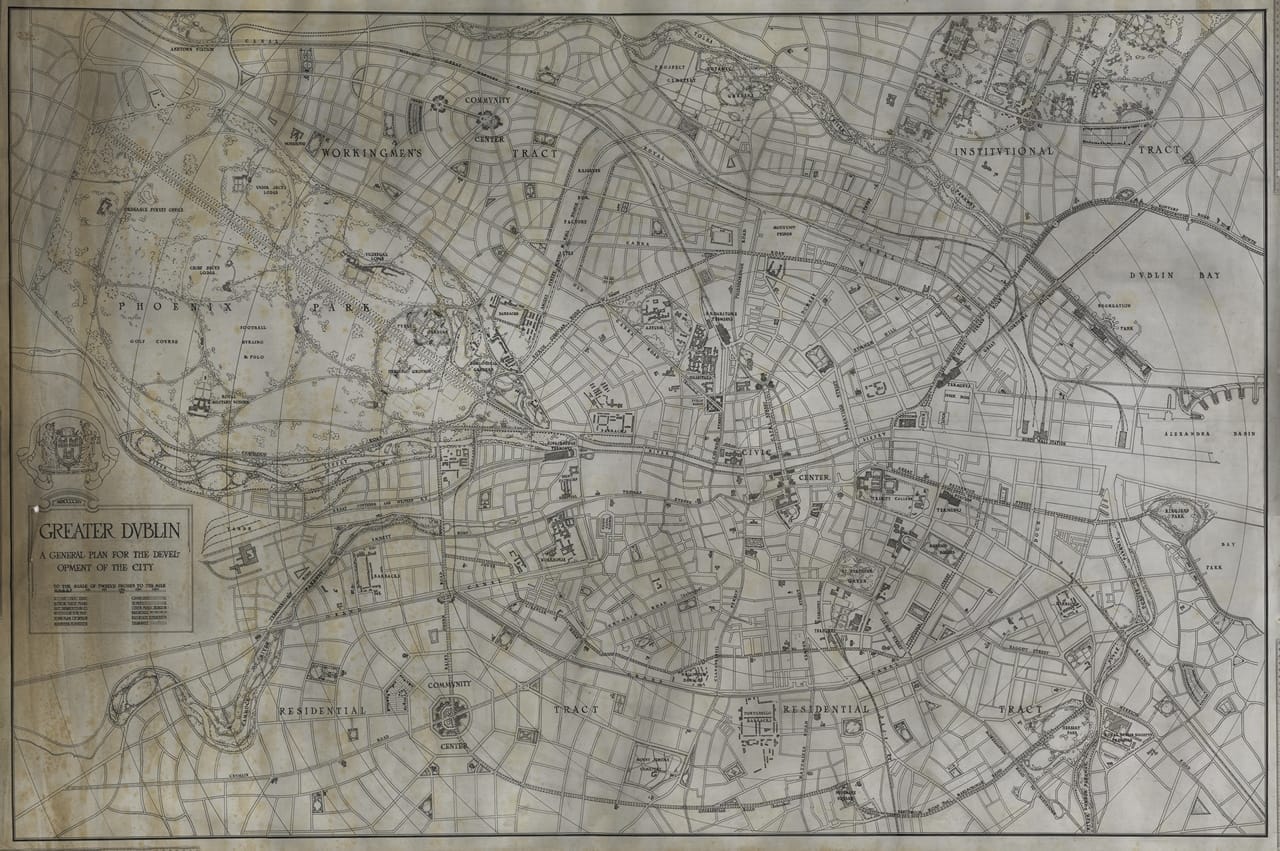
Describing itself as ‘an organisation with an open membership, founded on cooperative lines, to afford facilities for the study and investigation of those problems of Civics which affect the lives of all people’, the Civics Institute of Ireland was established in 1914. That same year, it organised an international competition ‘to elicit designs and reports of a tentative nature on a plan for ‘Greater Dublin’ calculated to suggest measures for the development of the City, and especially to outline proposals for meeting the housing needs of the population’.
A total of eight entries were accepted for consideration by the three adjudicators, pioneering town planner Patrick Geddes, Dublin City Architect Charles J. McCarthy, and American landscape architect and planning consultant, John Nolen. Frank Arthur (usually abbreviated to F. A.) Cushing Smith was the sole US entrant and one of only two single-person entrants. He submitted three sheets of drawings for consideration. The first was this General Plan for the development of Dublin. The second expanded on elements of the General Plan, including a proposed new civic centre running from City Hall via a new plaza on the site of Parliament Street and a widened Capel Street to a new Catholic Cathedral on a circus at the junction of Capel Street and Bolton Street. The third drawing detailed no less than nine different house types, ranging from two-bed bungalows to two-storey apartment blocks, all designed in a hybrid Arts and Crafts/Beaux-Arts style.
The outbreak of the First World War delayed the completion of the competition process. It was only in September 1916, as a deliberate contribution to the debates about rebuilding and urban planning swirling around Dublin in the aftermath of the Easter Rising, that the results were finally announced. Cushing Smith was one of four entrants given honourable mention by the adjudicators. The winning scheme by Patrick Abercrombie, Sydney Kelly and Arthur Kelly was finally published in 1922 under the optimistic title Dublin of the Future.