Skip to content
  • Catalogue
  • Dictionary of Irish Architects
  • Catalogue
  • Dictionary of Irish Architects
Menu

Menu

Proposed play for Greater Dublin by F. A. Cushing Smith, 1914.

Greater Dublin: General Plan of the Development of the City

F. A. Cushing Smith

1914

Ink on linen

IAA 2011/116.1

Planning by Crisis

Greater Dublin: General Plan of the Development of the City

F. A. Cushing Smith

1914

Ink on linen

IAA 2011/116.1

Describing itself as ‘an organisation with an open membership, founded on cooperative lines, to afford facilities for the study and investigation of those problems of Civics which affect the lives of all people’, the Civics Institute of Ireland was established in 1914. That same year, it organised an international competition ‘to elicit designs and reports of a tentative nature on a plan for ‘Greater Dublin’ calculated to suggest measures for the development of the City, and especially to outline proposals for meeting the housing needs of the population’.

A total of eight entries were accepted for consideration by the three adjudicators, pioneering town planner Patrick Geddes, Dublin City Architect Charles J. McCarthy, and American landscape architect and planning consultant, John Nolen. Frank Arthur (usually abbreviated to F. A.) Cushing Smith was the sole US entrant and one of only two single-person entrants. He submitted three sheets of drawings for consideration. The first was this General Plan for the development of Dublin. The second expanded on elements of the General Plan, including a proposed new civic centre running from City Hall via a new plaza on the site of Parliament Street and a widened Capel Street to a new Catholic Cathedral on a circus at the junction of Capel Street and Bolton Street. The third drawing detailed no less than nine different house types, ranging from two-bed bungalows to two-storey apartment blocks, all designed in a hybrid Arts and Crafts/Beaux-Arts style.

The outbreak of the First World War delayed the completion of the competition process. It was only in September 1916, as a deliberate contribution to the debates about rebuilding and urban planning swirling around Dublin in the aftermath of the Easter Rising, that the results were finally announced. Cushing Smith was one of four entrants given honourable mention by the adjudicators. The winning scheme by Patrick Abercrombie, Sydney Kelly and Arthur Kelly was finally published in 1922 under the optimistic title Dublin of the Future.
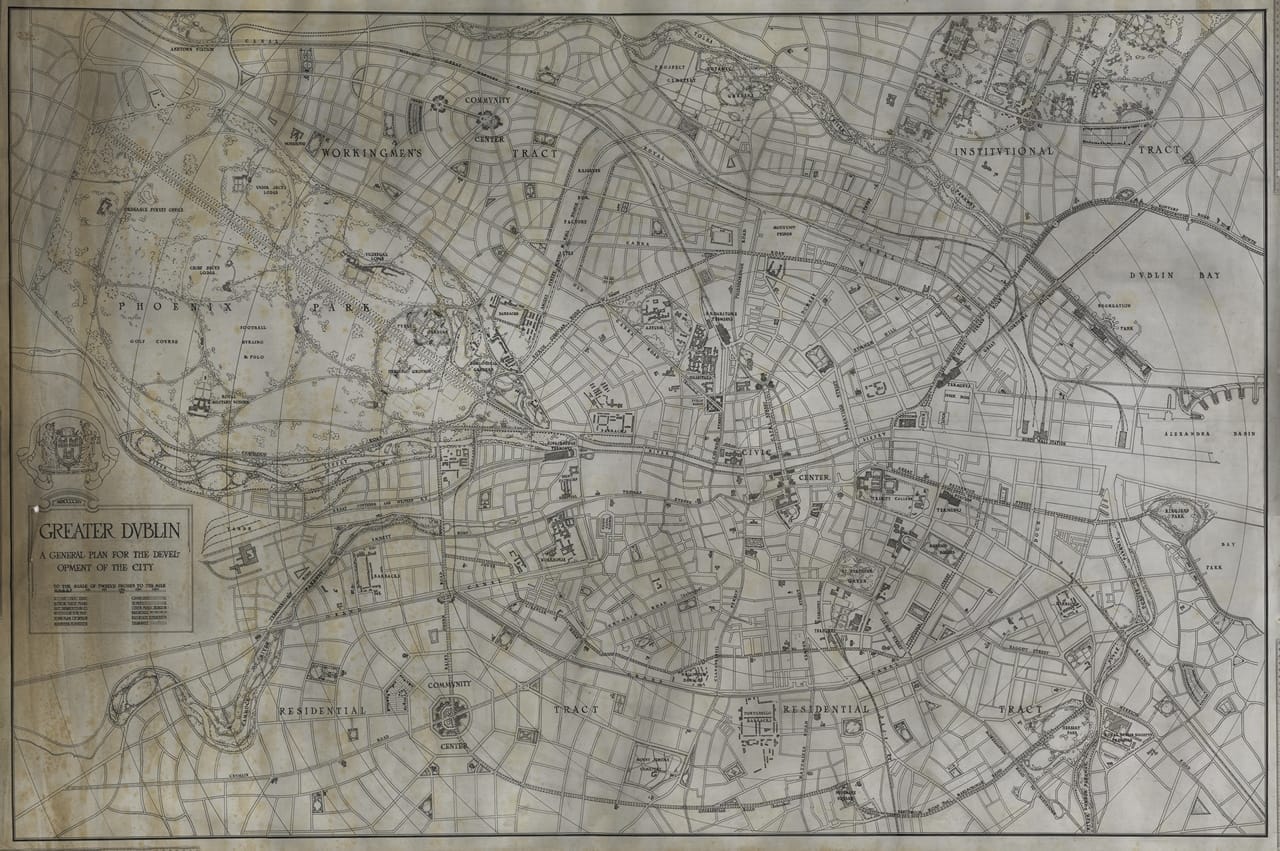
Proposed play for Greater Dublin by F. A. Cushing Smith, 1914.

Dublin’s Housing Crisis, 1900–1930. From Tenements to Garden Suburbs and Modern Flats

Anthony Reddy


In the midst of our current housing crisis, it is sobering to realise that for Ireland, and for Dublin in particular, housing has been a recurring problem for over two centuries. Indeed, as serious as our current crisis is, it pales in comparison to the situation which existed in the late nineteenth and early twentieth centuries.

There was a complex interplay between socio-economic decline, housing crises, and urban planning efforts in Dublin from the eighteenth century to the early twentieth century, by which point Dublin possessed some of the worst urban housing conditions in Europe. The city was notorious for its overcrowded tenements, high mortality rates, and repeated building collapses. Between 1900 and 1930, however, Dublin underwent a profound transformation in its housing landscape. This period witnessed the slow reform of the nineteenth‑century tenement system and the emergence of municipal housing, garden suburbs, and modern planning principles. The crisis was not merely architectural or demographic in nature; it was the outcome of deep‑seated economic decline, political paralysis, and social inequality. Structural neglect created extreme urban suffering; it was sustained state intervention which ultimately addressed the issue and reshaped the city.

Dublin’s housing crises cannot be understood without reference to the city’s long economic decline following the Act of Union in 1801. The removal of the Irish Parliament drained Dublin of political influence. Wealthy households, professionals, and investors gradually abandoned the city centre, depriving it of capital and employment. Unlike Belfast, which benefited from linen production and shipbuilding, Dublin failed to industrialise on a comparable scale. Employment was dominated by casual labour, small workshops, and domestic service, offering little stability for the working poor.

As the predominantly Unionist wealthy merchant, professional and business classes departed the urban area within the Royal and Grand Canals, Dublin’s built fabric deteriorated. Particularly in the north inner city, the Georgian houses built for the eighteenth‑century elite were no longer economically viable as single‑family residences. Instead of being replaced or comprehensively redeveloped, they were cheaply subdivided by speculative landlords into tenements, generally one‑room dwellings each occupied by a single family (15.1). This process maximised profit while requiring minimal investment. Rooms typically lacked running water, cooking facilities, or ventilation. Tenants shared a small number of outdoor taps and latrines, often located in yards or basements. These facilities were frequently blocked, overflowing, or inaccessible, forcing residents to dispose of waste in yards, stairwells, or nearby streets. Over time, maintenance was neglected and the buildings began to decay (15.2).

Black and white photograph of tenement houses on Bishop Street, Dublin, c. 1880.
15.1 Tenement houses, Bishop Street, Dublin, c. 1880 (IAA Photo Collection 49/91 V1)
Black and while photograph of Dublin slum dwelling known as Ward’s Cottages off Church Street, Dublin, circa 1900.
15.2 Ward’s Cottages, Church Street, Dublin, c. 1900 (IAA Photo Collection 9/25 V1)
Front cover of the Report of the Departmental Committee appointed by the Local Government Board for Ireland to Inquire into the Housing Conditions of the Working Classes in the City of Dublin, published in 1914.
15.3 Report of the Departmental Committee appointed by the Local Government Board for Ireland to Inquire into the Housing Conditions of the Working Classes in the City of Dublin (London, 1914) (IAA 2017/56)

Accelerated by the impacts of the Famine, by the late nineteenth century large sections of the north inner city had effectively become slums. Overcrowding was extreme. Families of six, eight, or even ten people occupied single rooms measuring little more than a few square metres. Lodgers were often taken in, to supplement income, further increasing density. Privacy was non‑existent, and domestic life was conducted under constant strain.

The public‑health consequences of Dublin’s housing conditions were catastrophic. Tuberculosis was endemic, thriving in damp, unventilated rooms, where sunlight rarely penetrated. Typhus, measles, and gastrointestinal diseases were common, particularly among children. Infant mortality rates in some inner‑city districts exceeded twenty percent, placing Dublin among the worst cities in Europe for child survival.

Housing conditions were closely linked to poverty and insecure employment. Many residents relied on casual dock work, street trading, or seasonal labour. Periods of unemployment meant hunger, rent arrears, and eviction. Families were trapped in a cycle of deprivation in which poor housing damaged health, ill health reduced earning capacity, and low income forced continued residence in the worst dwellings. The tenement was therefore not simply a physical structure but a mechanism through which poverty was reproduced.

Concern about Dublin’s housing conditions emerged long before 1900, but early reform efforts were limited and fragmented. Organisations such as the semi-philanthropic Dublin Artisans’ Dwellings Company and the philanthropic Iveagh Trust constructed improved housing for skilled workers. These developments demonstrated that healthy, well‑designed housing could be built at scale. However, as a solution they remained marginal relative to the enormous need, and their rents excluded the poorest families.

Dublin Corporation, the city’s municipal authority, proved largely ineffective before the First World War. Its powers were limited, its finances constrained, and its political will compromised. Some councillors were themselves tenement landlords, creating clear conflicts of interest. Sanitary regulations were weakly enforced, and slum clearance progressed slowly. As a result, the housing situation deteriorated steadily despite repeated warnings from medical officers and social reformers.

The fragility of Dublin’s tenement system was brutally exposed in 1913 when two buildings collapsed on Church Street, killing several residents. The disaster occurred during the Dublin Lockout, a period of intense industrial conflict that heightened awareness of working‑class suffering. Public outrage followed, and the incident became a catalyst for political action.

In response, the British administration established the Departmental Committee to Inquire into the Housing Conditions of the Working Classes in the City of Dublin. The report, published in February 1914 (15.3), revealed conditions of shocking severity. The Committee concluded that Dublin’s housing conditions were worse than those of any other large city in the United Kingdom, and their report called for large‑scale slum clearance, new housing construction, and professional planning expertise.

A month after the Housing Inquiry report was published, in March 1914 the Civics Institute of Ireland was established. In August 1914 the Civics Institution organised the Dublin Civic Exhibition, an event which introduced contemporary planning theory to Irish audiences. Influenced by the work of Patrick Geddes, the Exhibition emphasised the importance of comprehensive surveys linking housing, health, employment, and environment. Geddes argued that cities should be understood organically, with planning guided by social needs rather than speculative profit.

Alongside the Exhibition, an International Town Planning Competition was launched to envision Dublin’s future. The competition produced ambitious proposals, with entries coming from as far away as the United States (15.4), but the promulgation of these ideas was delayed by the outbreak of the First World War. It was not until the aftermath of the 1916 Rising that the entries were exhibited, and it would take until 1922 for the winning entry to be published under the title Dublin of the Future. The winning scheme by architect and town planner Patrick Abercrombie, with surveyor Sydney Kelly and his brother Arthur Kelly, advocated extensive slum clearance, low‑density garden suburbs, improved traffic circulation, and a rationalised civic centre modelled on Haussmann’s urban interventions in central Paris (15.5). These ideas challenged the incremental approach that had previously dominated municipal policy, as urban reformers increasingly embraced modern planning ideas that viewed housing as part of a wider social and spatial system rather than an isolated technical problem.

Housing Plans for Greater Dublin by F. A. Cushing Smith, 1914.
15.4 F. A. Cushing Smith, Housing Plans for Greater Dublin, 1914 (IAA 2011/116.3). Detail
Plan of proposed layout of Dublin from Dublin of the Future: The New Town Plan by Patrick Abercrombie, Sydney Kelly and Arthur Kelly, published in 1922.
15.5 Patrick Abercrombie, Sydney Kelly and Arthur Kelly, Dublin of the Future: The New Town Plan (Dublin, 1922) (IAA 2024/35.1). Plan 1, ‘Periods of Execution in 3 Degrees of Urgency’

A further consequence of the 1916 Rising was the empowerment under the Dublin Reconstruction (Emergency Provisions) Act 1916 of the Dublin City Architect to oversee, approve, or reject building plans to ensure ‘a uniform and dignified appearance’ for the city’s main thoroughfare, then known as Sackville Street. City Architect Charles J. McCarthy and his successor Horace Tennnyson O’Rourke were responsible for pushing a neoclassical aesthetic, requiring a single parapet line and the use of stone for facades, particularly on the east side of Upper O’Connell Street. Following further damage caused by fighting in 1923, and act was passed in 1924, similar to the 1916 act, allowing O’Rourke to enforce the same strict planning guidelines to create a coherent urban design form (15.6).

Architectural drawing by Horase Tennyson O'Rourke, Dublin CIty Architect, showing the elevation of buildings to be erected during the reconstruction of O’Connell St Dublin in 1927.
15.6 City Architect’s Department, Reconstruction of O’Connell St Dublin, Amended Sketch Design Frontage Co-ordination, 1927 (IAA W.H. Byrne & Son Collection 2006/142.610.1)

The establishment of the Irish Free State in 1922 marked a turning point in housing policy. The new government inherited a city burdened by severe shortages and dangerous buildings. Housing reform became both a social necessity and a symbol of state legitimacy. Although resources were limited in the aftermath of civil war, the government recognised that inaction would perpetuate humanitarian disaster. The 1922 ‘Million Pound Scheme’ of the first Free State government sought to stimulate construction and employment while addressing housing need. One of its most significant outcomes was the Marino estate, built between 1924 and 1929 (15.7). Marino represented Dublin’s first large‑scale garden suburb, combining low density, green space, and high building standards. Houses included indoor sanitation, baths, and gardens, offering a dramatic improvement on tenement housing.

While Marino demonstrated the potential of state‑supported housing, it also exposed important limitations. Many houses were sold rather than rented at low cost, excluding the poorest families. As a result, the inner‑city slums remained heavily populated throughout the 1920s. The garden suburb improved conditions for a segment of the working class but did not yet resolve the crisis at its core. The experience highlighted the need for more direct municipal intervention and greater subsidies if slum clearance was to succeed on a meaningful scale. These lessons would shape policy in the following decade.

A decisive shift occurred after 1932 with the election of a government committed to large‑scale social reform. New housing legislation significantly increased subsidies for local‑authority building, particularly for rehousing families displaced by slum clearance. City Architect Horace T. O’Rourke implemented a series of initiatives to address the challenge and meet the Government’s housing programme. He expanded Dublin Corporation’s architectural department and created the role of Housing Architect, a position to which Herbert Simms was appointed in late 1932. O’Rourke and Simms oversaw one of the most ambitious municipal housing programmes in Europe. Thousands of houses were constructed in suburban estates such as Crumlin, Cabra, Drimnagh, and Kimmage (15.8). These developments provided three‑bedroom houses with gardens, modern sanitation, and access to light and air.

Plans of Croydon Park Housing Scheme and Marino Housing Scheme from The Dublin Civic Survey published in 1925.
15.7 Horace T. O’Rourke and the Dublin Civic Survey Committee for the Civics Institute of Ireland, The Dublin Civic Survey, London, 1925 (IAA 2024/32.2). Plates XL and XLI, ‘Croydon Park Housing Scheme’ and ‘Marino Housing Scheme’
Architectural drawing by Dublin Corporation Housing Architects Department, for a Four Room House, 1942.
15.8 Dublin Corporation Housing Architects Department, Amended Four Room House, 1942 (IAA 2021/54 Type4A and 4B)

At the same time, Simms designed inner‑city flat complexes to accommodate families whose livelihoods depended on proximity to the docks and city centre. Inner‑city schemes such as Pearse House, St Joseph’s Mansions (now Killarney Court) and Chancery House replaced collapsing tenements with durable, well‑planned apartment blocks. These buildings incorporated modernist design principles, communal courtyards, balconies, and private sanitation. Crucially, Simms resisted cost‑cutting measures that would have compromised quality, warning that poorly built housing would merely reproduce slum conditions.

Under O’Rourke and Simms, the City Architect’s Department evolved from acting as a regulatory, controlling force on O’Connell Street to being a proactive designer of social housing, creating a legacy of grand neoclassical streetscapes, functional inner-city apartments and garden suburb housing.

Between 1900 and 1930 Dublin underwent one of the most dramatic housing transformations in Europe. The collapse of the tenement system and the rise of municipal housing reflected not only architectural change but a profound shift in political priorities and social responsibility. By the late 1930s, the impact of these policies was evident. Overcrowding declined sharply, tuberculosis rates fell, and infant mortality improved. Dublin’s population expanded into new suburbs, fundamentally altering the city’s form and social geography. Although the solutions adopted created new challenges, they demonstrated that sustained public intervention could reverse even the most entrenched urban crises. The legacy of this period continues to shape Dublin today and offers enduring lessons for cities confronting housing inequality in the modern era.


Tony Reddy is the Chairman of Reddy Architecture + Urbanism and Chairperson of the Irish Architectural Archive. He is a former President of the Royal Institute of the Architects of Ireland and the Architectural Association of Ireland and former Chairperson of the Academy of Urbanism.


Back to main Pivot Points page.

Donate

Large or small, every donation helps secure the future of the collection. We are truly grateful for your support.

Donate now

Donate

Large or small, every donation helps secure the future of the collection. We are truly grateful for your support.

Donate now

Follow us

  • Facebook
  • Instagram
  • Linkedin

Address

45 Merrion Sq.
Dublin 2
D02 VY60

Contact

01 663 3040
info@irisharchitecturalarchive.ie

English | As Gaeilge

  • English

Opening Hours

Reading Room

10am-5pm, Tuesdays to Fridays; Mondays by appointment

Exhibitions

10am-5pm, Mondays to Fridays

Newsletter

Stay in touch, receive updates about exhibitions and events

Subscribe

English | As Gaeilge

Menu
  • Catalogue
  • Dictionary of Irish Architects
  • About Us
    • About
    • Board
    • Members
    • Staff
    • Annual Reports
    • Contact
  • Our Collections
    • Collections
    • Online Catalogue
  • Our Exhibitions
    • Current Exhibitions
    • Past Exhibitions
  • Our Building
    • No. 45 Merrion Square
    • Venue Hire
  • Access
    • Visit
    • Reading Room
  • Support us
    • Donate
    • Major Sponsors
Search this site

Subscribe

* indicates required

The Irish Architectural Archive will use the information you provide on this form to send you its regular Newsletter. Please confirm that you would like to hear from us:

You can change your mind at any time by clicking the unsubscribe link in the footer of any email you receive from us, or by contacting us at info@iarc.ie. We will treat your information with respect. By clicking below, you agree that we may process your information in accordance with these terms.

We use Mailchimp as our marketing platform. By clicking below to subscribe, you acknowledge that your information will be transferred to Mailchimp for processing. Learn more about Mailchimp's privacy practices.

  • English