Skip to content
  • Catalogue
  • Dictionary of Irish Architects
  • Catalogue
  • Dictionary of Irish Architects
Menu

Menu

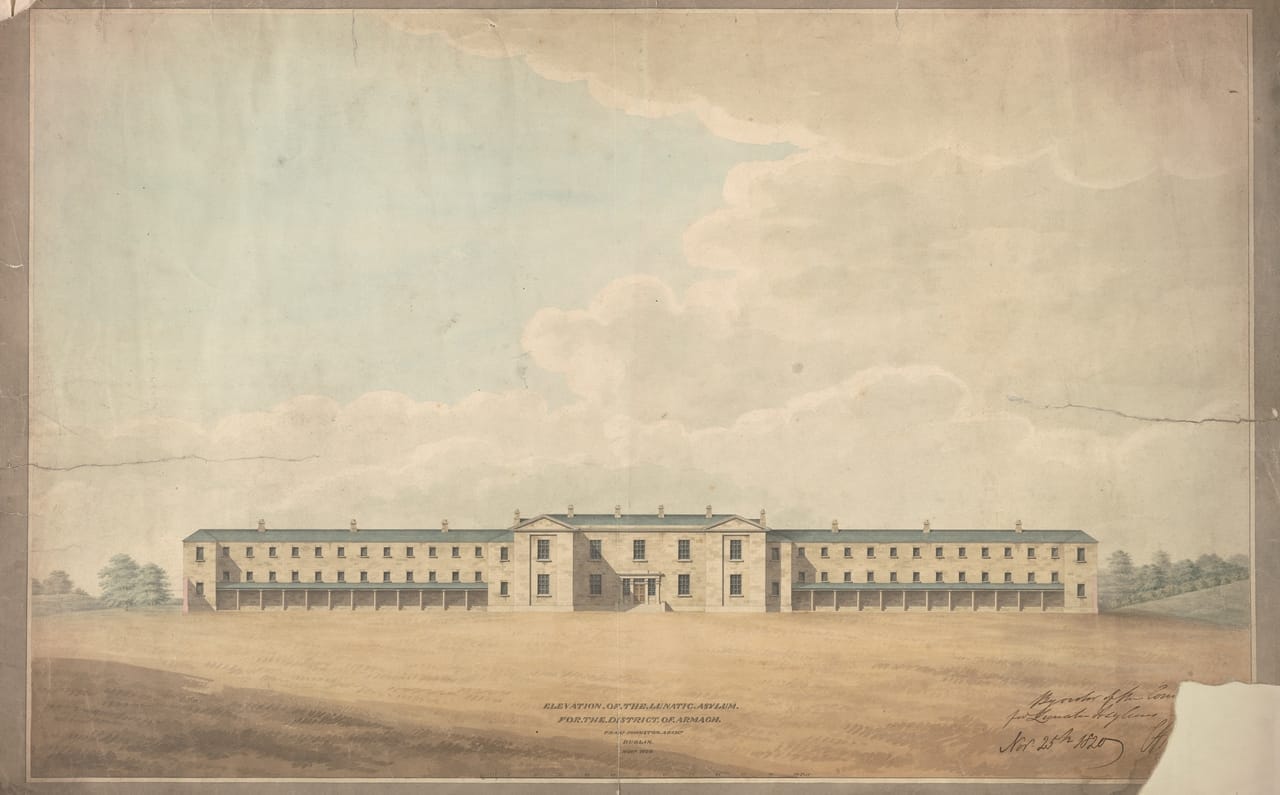
Elevation of the Lunatic Asylum for the District of Armagh

Francis Johnston

1820

Ink and colour wash on paper

IAA RIAI Murray Collection 92/46.66

Building by Government I: Lunatic Asylums

Elevation of the Lunatic Asylum for the District of Armagh

Francis Johnston

1820

Ink and colour wash on paper

IAA RIAI Murray Collection 92/46.66

A House of Commons Select Committee established ‘to Consider the State of the Lunatic Poor in Ireland’ issued a report in 1817 which led to the passing that same year of the Establishment of Asylums for the Lunatic Poor in Ireland Act. This act was amended in 1820 and again in 1821. Cumulatively these pieces of legislation enabled the division of Ireland into a number of districts and provided that ‘all lunatic poor within every such district respectively shall be maintained and taken care of in the asylum belonging to such district’. Ireland was to become the first country in the world to have a system of publicly funded asylums for the mentally ill.

Nine asylums were built in the first programme of construction under the auspices of the Commissioners for the Erection of Lunatic Asylums. Francis Johnston, architect to the Board of Works since 1805, secured the appointment as architect to the Commission. In the delivery of the buildings, he was assisted by his cousin William Murray who succeeded as the Commission’s architect after Johnston’s death in 1829.

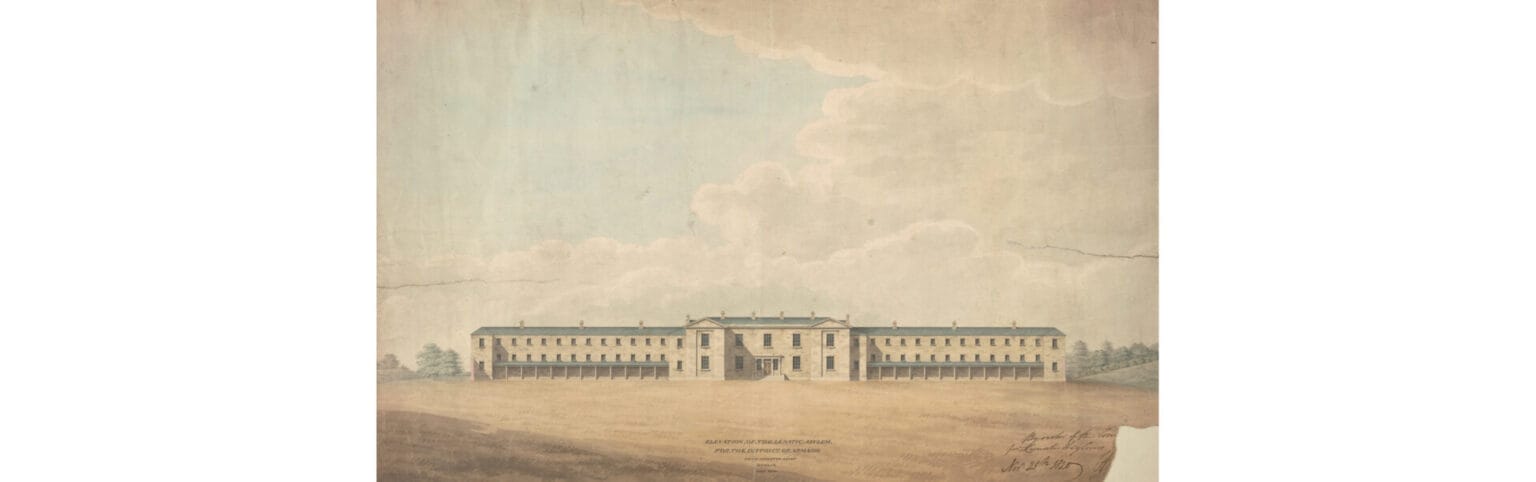
The asylum at Armagh was the first to be designed and built. As evident in this front elevation, a dignified, unadorned, Classical style was chosen as the appropriate external expression for the building. A cupola, missing from the drawing, was added during construction. The plan indicates that the architects were aware of recent innovations in the care of the mentally ill. Whereas previous asylums had resembled prisons, at Armagh the central five-bay block contained the Governor’s residence and large day-rooms. This was flanked on each side by long wings containing ‘Closets’ or cells, and larger ‘Sleeping Rooms for Convalescents’.

Armagh Asylum opened in 1825. It was the model for Limerick (1826), Belfast and Derry (both 1829), Carlow (1832), Ballinasloe, Maryborough (Portlaoise) and Waterford (all 1833), and Clonmel (1835). Much altered, it continues to serve as St Luke’s Hospital.
An institutional building programme

Patrick Quinlan

Amidst the tree studded parkland of the building once known as the Armagh District Lunatic Asylum stands a commemorative stone marking two centuries since the establishment of ‘the first purpose built hospital of its kind in Ireland and the western world under mandatory law.’ It may seem like a heavily qualified claim to fame, meriting perhaps a footnote in the international history of mental healthcare. However, the erection of a prototype public mental institution in a small provincial city of the world’s most powerful empire presaged a shift in the relationship between central government and its citizens which reverberates to this day.(1)

To understand why, it is necessary to unpick two centuries of accumulated expectations around the role of a national government. As it emerged victorious from the Napoleonic Wars, the United Kingdom of Great Britain and Ireland was a nation state in recognisably modern form, with codified laws, formalised taxation, and armed forces answerable to a central, civilian government. But, at risk of gross simplification, the Westminster government of the 1810s was primarily concerned with expanding its empire, securing its external borders, and maintaining order within them.(2) In the Irish context, this manifested in an abundance of military barracks, prisons and courthouses, and a relative absence of much else.

Insofar as the central state concerned itself with the health, education or welfare of its citizens in the late eighteenth and early nineteenth centuries, it did so by passing legislation to expand the purposes for which local government was permitted to levy taxation but seldom obliged them to do so.(3) The provision of social infrastructure thus depended on the initiative of local ‘grand juries’, most of which were better known for corruption than competence. The result was an uneven patchwork of welfare institutions, hospitals and schools funded by various combinations of statutory local taxation, voluntary subscription, and religious bodies. More often, they were wholly absent. In the specific area of provision for the mentally ill, three decades after legislation of 1787 which empowered grand juries to erect dedicated lunatic wards, barely a quarter of them had done so.(4)

As the apparent madness of the monarch Geroge III propelled lunacy reform up the political agenda of Regency England, a House of Commons select committee was convened in 1817 to enquire specifically into the ‘expediency of making provision for the relief of the lunatic poor in Ireland’. The committee surveyed both the quality and quantity of ‘lunatic wards’ across Ireland. Many fell grotesquely short; in the particularly egregious ward attached to the Limerick House of Industry, it was recorded that patients chained in filthy and freezing cells lost limbs to frostbite.(5)

In mandating the statutory provision of a national asylum system, the committee’s final report declared their ‘benevolent intentions… to contribute to the cure of malady and the alleviation of wretchedness’ and asserted that ‘the relief and care [of the lunatic poor] is the duty of the State.’(6) This interventionist stance reflected the influence of liberal Whigs such as Sir John Newport and Thomas Spring Rice; perhaps more surprisingly, the ruling Tory government did not demur. Both Westminster parties were acutely aware of the failings of Ireland’s weak and corrupt grand jury system of local government, albeit opposed on what, if anything, to do about it.(7) So a proposal which the Whigs celebrated as a victory for humanitarianism, the Tories might have regarded as a lesser evil than local government reform. Both sides also appreciated that the British state needed to engage in ‘constructive unionism’ to win over an Irish polity embittered by the loss of its own parliament.(8) Conspicuously humane provision for a self-evidently ‘deserving’, but numerically tiny, subset of Ireland’s impoverished millions must have seemed like an attractive and affordable option.

After legislating for the western world’s first statutory national public asylum system came the task of actually creating it. Existing provision was clearly inadequate but one asylum per county seemed excessive. The committee therefore recommended the erection of four or five new asylums around the country, funded from local taxation levied on the several counties of which each district would be composed.(9) If the tension between quality and accessibility of healthcare is familiar from contemporary debates, then it is also unsurprising that competition for the perceived advantages of hosting an asylum saw ‘four or five’ rise to nine. Over the course of another century, the total would reach twenty-nine.

The committee further prescribed that ‘the successful treatment of the insane [depends] more upon the adoption of a regular system of moral treatment than upon casual medical prescription’.(10) The reference to ‘moral treatment’ or ‘moral management’ describes a new emphasis on the humane encouragement of patients to exercise self-restraint, eschewing the coercive and medicalised approaches then prevailing. A new type of treatment would seem to demand a new type of architecture, but on this point the committee was ambivalent, delegating such decisions to the expansively titled ‘Commissioners for General Control & Correspondence & for Superintending & Directing the Erection, Establishment & Regulation, of Asylums for the Lunatic Poor in Ireland’. The Commissioners initially consulted Francis Johnston, architect to the Board of Works, on the feasibility of adapting existing barrack buildings, but Johnston concluded that ‘from the experience I have had in converting old buildings from one use to another, I have never yet found the object wished for attained, nor in the end, any saving in expense worth consideration’.(11)

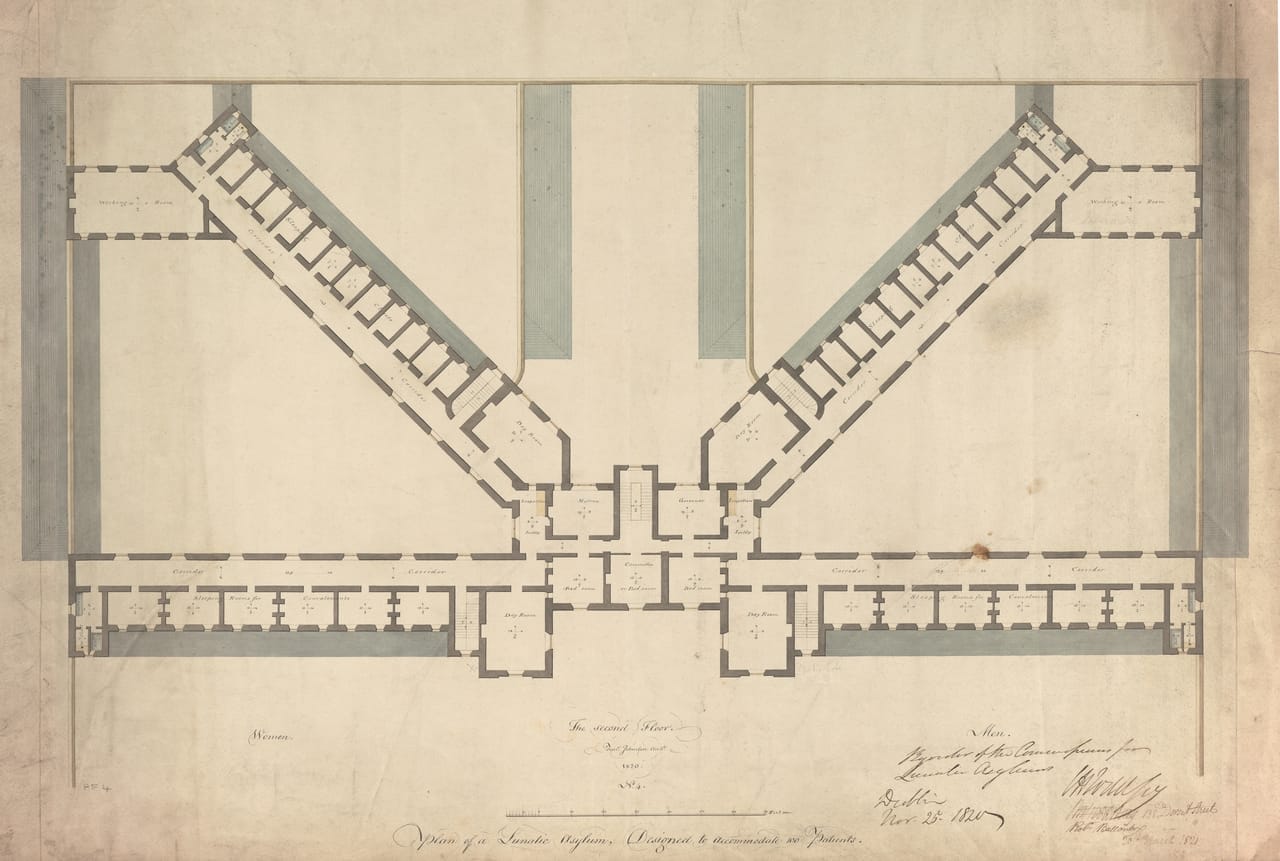
Plan by Francis Johnston of the Second Floor, Armagh Lunatic Asylum, 1820.
8.1 Francis Johnston, The Second Floor, Armagh Lunatic Asylum, 1820 (IAA RIAI Murray Collection 92/46.65)

The Commissioners instead retained Johnston to prepare standardised plans for new-build asylums to meet the functional requirements of moral management.(12) Johnston’s plan lodged patients in single cells or small shared rooms along ‘galleries’ in four wings radiating from a central governor’s house, under whose ‘moral influence’, or watchful eye, they dwelt (8.1). Dayrooms, airing yards and covered promenades were provided for each wing, while convalescent patients could enjoy the landscaped grounds in which each asylum was set. The Commissioners commended Johnston’s design as ‘having been designed devoid of all unnecessary Decorations, in conformity with our explicit directions’,(13) and his resulting design for Armagh was certainly restrained. In declining to employ any of the major architectural orders on classically proportioned buildings, Johnston and his client were conveying a careful value judgement on the appropriate appearance of buildings of public charity. In this they were almost certainly influenced by the criticisms of external monumentality and internal dysfunction levelled against London’s recently completed new Bethlem hospital.(14)

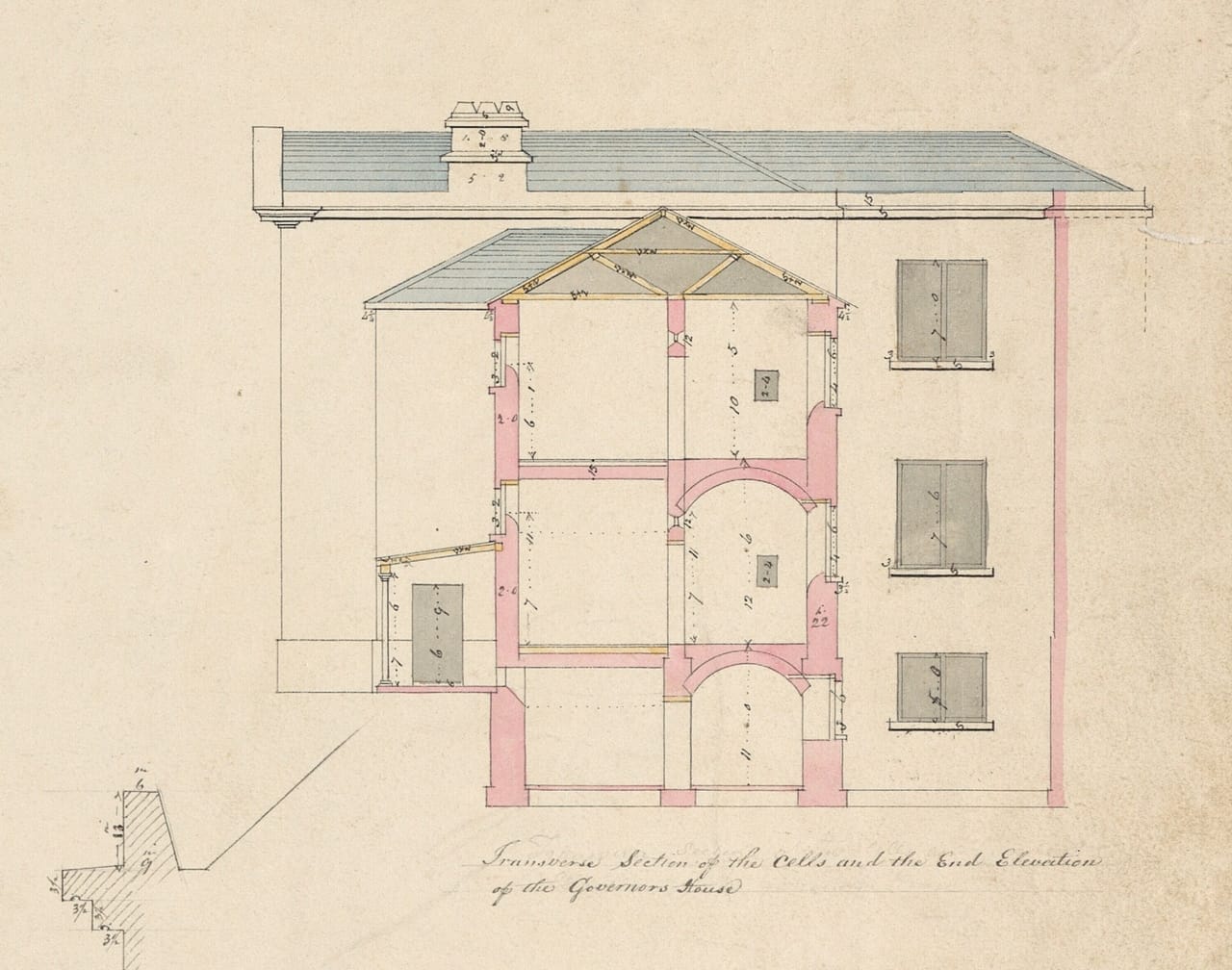
While the quasi-domestic architectural quality of Armagh’s central block could be read as an attempt by Johnston to convey the asylum’s role as the setting for the ‘moral family’ of the governor and his patients, it is also true that most institutions of the Georgian period invoked the design language of the private mansion. In the patient wings, however, we can see Johnston’s external appearance in direct tension with the inner reality. Cell windows that appear tolerably generous in elevation were in truth only half as large internally, and too high above floor level to afford the occupant any meaningful view (8.2). Small, high cell windows were accepted practice in the design of 1820s asylums. It is the calculated deception that intrigues.

Drawong by Francis Johnston and William Murray showing the transverse section of the cells and the end elevation of the Governors House, Belfast Lunatic Asylum, 1827.
8.2 Francis Johnston and William Murray, Transverse Section of the Cells and End Elevation of the Governors House, Belfast Lunatic Asylum, 1827 (IAA RIAI Murray Collection 92/46.110). Detail

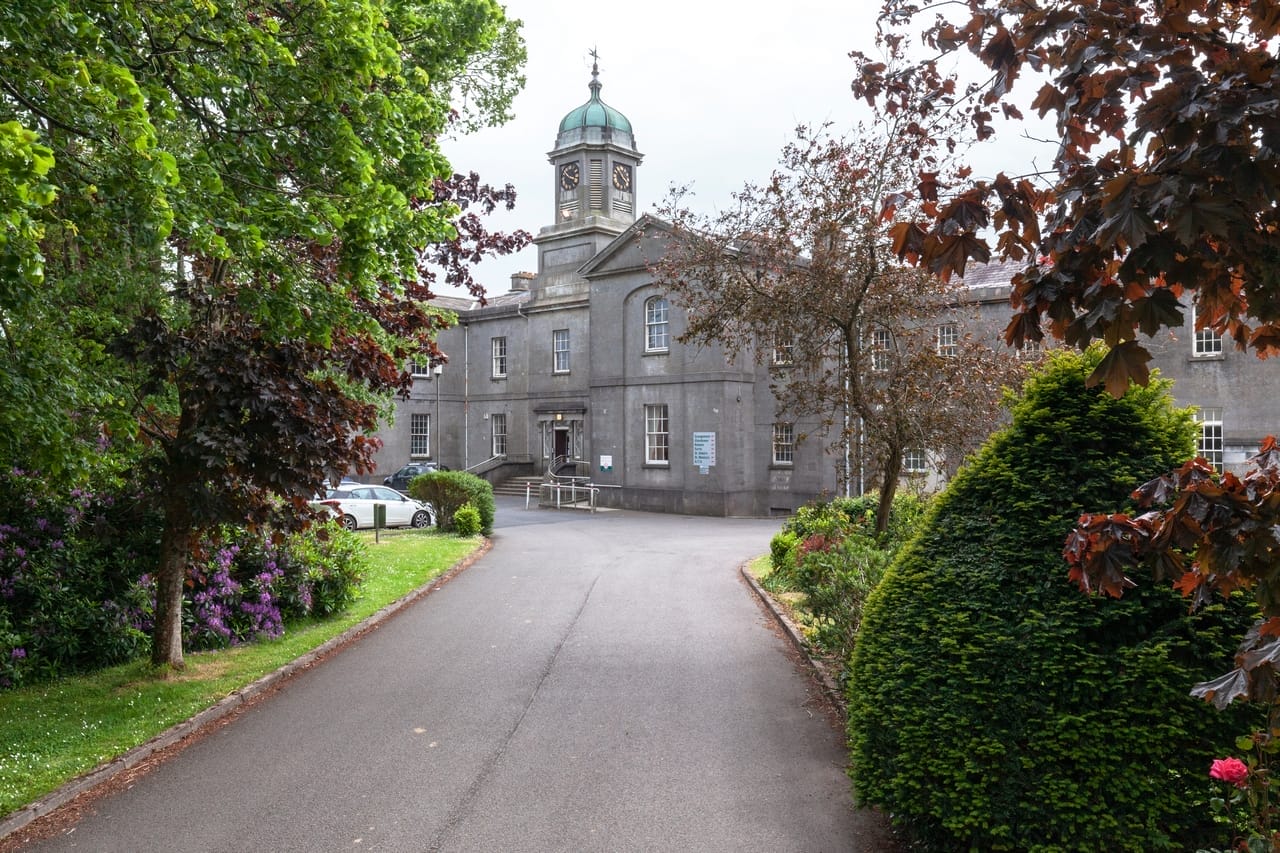
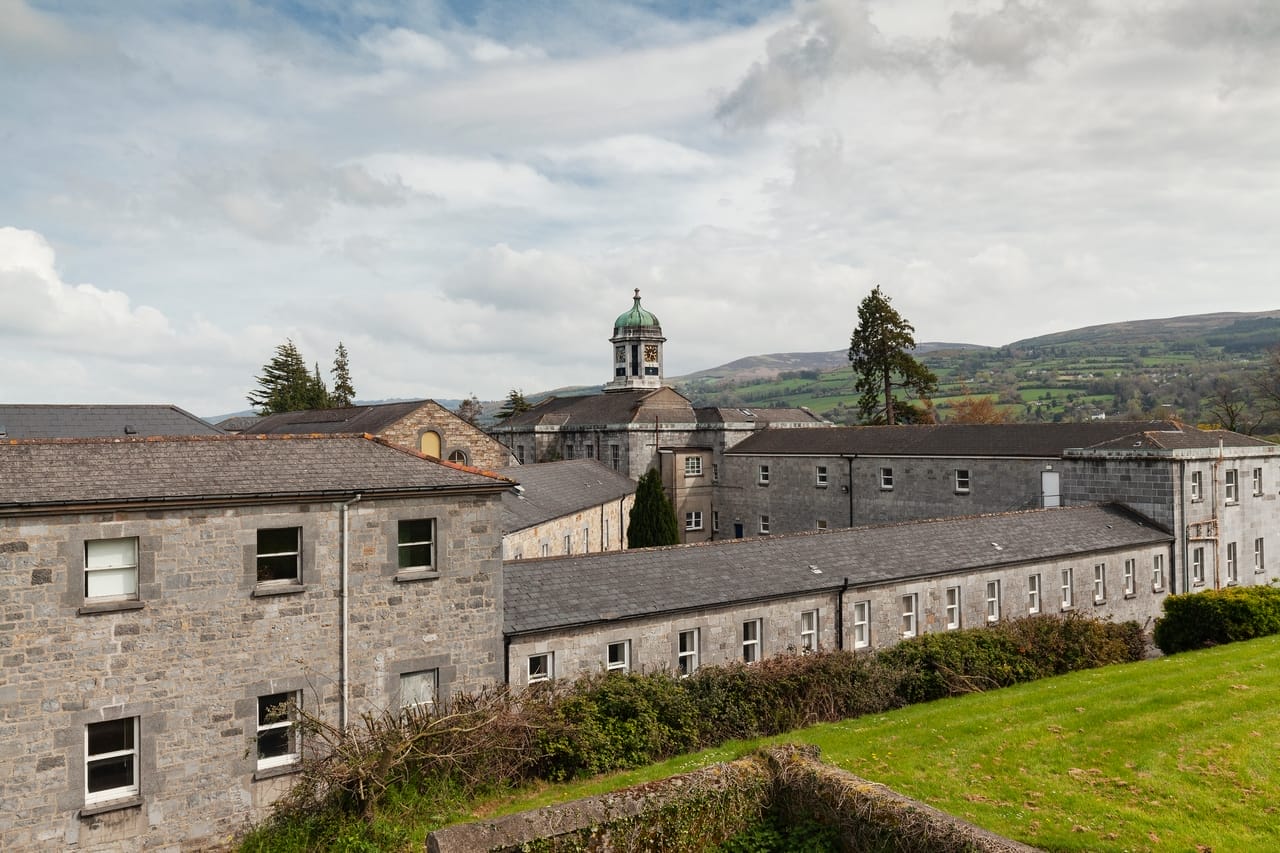
Perhaps the most notable aspect of the main elevation drawing for Armagh is what is omitted – there is no sign of the cupola which would become a defining feature of this and each of Johnston’s subsequent asylums. Did it become apparent, as this finely executed public building neared completion, that it could not actually be seen by the public that paid for it? It seems probable that the belated addition of the cupola at Armagh was intended to communicate the building’s civic credentials to an audience beyond its high boundary walls. And in what may have been another lesson learned from Armagh, Johnston, and his nephew and business partner William Murray, developed an appreciation for the asylum as both subject and object of distant views in a wider landscape, as at Belfast: ‘beautifully placed’, Limerick: ‘very beautifully situated… commanding a fine view’, and Derry: ‘a very conspicuous situation, and well circumstanced in aspect…’(15) Far from being urban set-pieces, both architects framed the new asylums in terms similar to contemporary mansions in pastoral landscapes, characteristics which have only improved with age, as at Waterford (8.3) and Clonmel (8.4).

Photograph of St Otteran's Hospital (former Lunatic Asylum), Waterford,, by David Killeen photographer, 2019.
8.3 St Otteran's Hospital (former Lunatic Asylum), Waterford, , David Killeen photographer, 2019 (IAA Walls of Containment Photographs Collection 2026/11.9/1)
Photograph of St Luke's Hospital (former Lunatic Asylum), Clonmel, Co. Tipperary, by David Killeen, 2019.
8.4 St Luke's Hospital (former Lunatic Asylum), Clonmel, Co. Tipperary, David Killeen photographer, 2019 (IAA Walls of Containment Photographs Collection 2026/11.10/3)
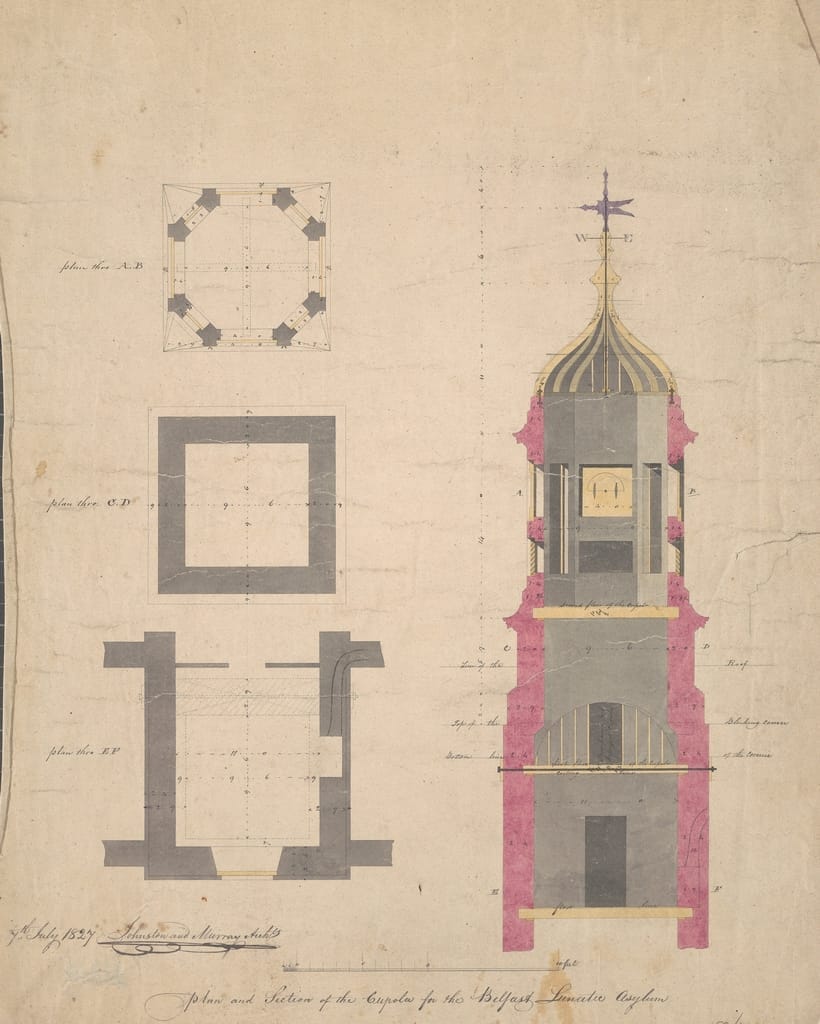
Drawing by Francis Johnston and William Murray for the Cupola of Belfast Lunatic Asylum, 1827.
8.5 Francis Johnston and William Murray, Plan and Section for Cupola for the Belfast Lunatic Asylum, 1827 (IAA RIAI Murray Collection 92/46.117)

For those within the walls, the cupola conveyed more than just civic values; it acted as a symbolic marker of the authority of the moral governor at the centre of the institution (8.5). It mattered not that the cupola was useless for surveillance and housed nothing more sinister than the asylum clock. Its dominant position astride the governor’s house made it a physical proxy for the ‘all-seeing eye’ on which this early brand of moral management depended. Boiled down to its essence, I consider that Johnston’s asylum architecture conveyed a simple message to the social classes for whom it was built: ‘Trust and Obey.’(16)

Armagh’s asylum heralded a system of cure, care and containment that, at its peak, accommodated over 25,000 patients on the island of Ireland. But the building’s significance arguably resonates beyond this island’s shores. For having mandated for Ireland a statutory, standardised national network of lunatic asylums in 1817, the interventionist hand of the central British state repeated the act in respect of primary schools (1831), workhouses (1838), third level colleges (1845) and medical dispensaries (1851).(16) And while Westminster later shifted to a model which effectively outsourced welfare provision in Ireland to religious bodies (e.g., industrial schools, 1868), the principle that the ‘relief and care [of the vulnerable] is the duty of the State’ took root within the home nations of the United Kingdom, and spread, through its empire, around the globe. The optimal size of the state divides political opinion in every generation, but none have managed to put the genie released at Armagh in 1824 back in the bottle.

Footnotes:

1 Thomas Bartlett, ‘Ireland during the Revolutionary and Napoleonic Wars, 1791–1815’, James Kelly ed., The Cambridge History of Ireland, Volume 3, 1730-1880 (hereafter CHOI, Vol. 3) (Cambridge, 2018), 74–101, (101).

2 The modest obligation to erect County Infirmaries, mandated under acts of 1766 and 1808, was a rare exception.

3 27 Geo. III c. 39, Section 8, and authors statistical analysis of the Report from the Select Committee on the Lunatic Poor in Ireland, HC 1817 [430] viii (hereafter Select Committee Report, 1817).

4 ibid., 12-15.

5 ibid., 4.

6 Virginia Crossman, Local Government in Nineteenth-Century Ireland (Belfast, 1994), 30-7.

7 Virginia Crossman, ‘The Growth of the State in the Nineteenth Century’, in CHOI, Vol. 3, 542–66, (548).

8 Select Committee Report, 1817, 4, 10, 30-3.

9 ibid., 4.

10 Letter from Francis Johnston to Commissioners, 21 Nov 1817, Minute book of the Commissioners for General Control & Correspondence National Archives of Ireland (NAI) 999/784, 33-4.

11 Notwithstanding a representation made by the Chief Secretary of Ireland (later Prime Minister) Robert Peel on behalf of renowned English asylum architect James Bevans, ibid., 12-13.

12 Letter, Commissioners to Robert Peel, Chief Secretary, 5 Jan. 1818, National Archives of Ireland (NAI 999/784, 27-31.

13 Christine Stevenson, Medicine and Magnificence: British hospital and asylum architecture, 1660-1815 (London and New Haven, 2000) 95-102, 206-12.

14 Letter from Francis Johnston to Commissioners, 17 April 1821. Letter, Commissioners to Chief Secretary, 5 February 1822. Letter, William Morrison to Commissioners, 29 May 1826. Minute book NAI 999/784, 127-8, 164, 332.

15 Patrick Quinlan, Walls of Containment: The Architecture and Landscapes of Lunacy (Dublin, 2021), 34-5, 63-5, 151-2.

16Virginia Crossman, ‘The Growth of the State in the Nineteenth Century’, CHOI, Vol. 3, 542–66, (542).


Dr Patrick Quinlan is a practicing architect who holds a PhD from Birkbeck, University of London, which explored the long lives and layered meanings of Ireland’s institutional architecture.

Donate

Large or small, every donation helps secure the future of the collection. We are truly grateful for your support.

Donate now

Donate

Large or small, every donation helps secure the future of the collection. We are truly grateful for your support.

Donate now

Follow us

  • Facebook
  • Instagram
  • Linkedin

Address

45 Merrion Sq.
Dublin 2
D02 VY60

Contact

01 663 3040
info@irisharchitecturalarchive.ie

English | As Gaeilge

  • English

Opening Hours

Reading Room

10am-5pm, Tuesdays to Fridays; Mondays by appointment

Exhibitions

10am-5pm, Mondays to Fridays

Newsletter

Stay in touch, receive updates about exhibitions and events

Subscribe

English | As Gaeilge

Menu
  • Catalogue
  • Dictionary of Irish Architects
  • About Us
    • About
    • Board
    • Members
    • Staff
    • Annual Reports
    • Contact
  • Our Collections
    • Collections
    • Online Catalogue
  • Our Exhibitions
    • Current Exhibitions
    • Past Exhibitions
  • Our Building
    • No. 45 Merrion Square
    • Venue Hire
  • Access
    • Visit
    • Reading Room
  • Support us
    • Donate
    • Major Sponsors
Search this site

Subscribe

* indicates required

The Irish Architectural Archive will use the information you provide on this form to send you its regular Newsletter. Please confirm that you would like to hear from us:

You can change your mind at any time by clicking the unsubscribe link in the footer of any email you receive from us, or by contacting us at info@iarc.ie. We will treat your information with respect. By clicking below, you agree that we may process your information in accordance with these terms.

We use Mailchimp as our marketing platform. By clicking below to subscribe, you acknowledge that your information will be transferred to Mailchimp for processing. Learn more about Mailchimp's privacy practices.

  • English