Skip to content
  • Catalogue
  • Dictionary of Irish Architects
  • Catalogue
  • Dictionary of Irish Architects
Menu

Menu


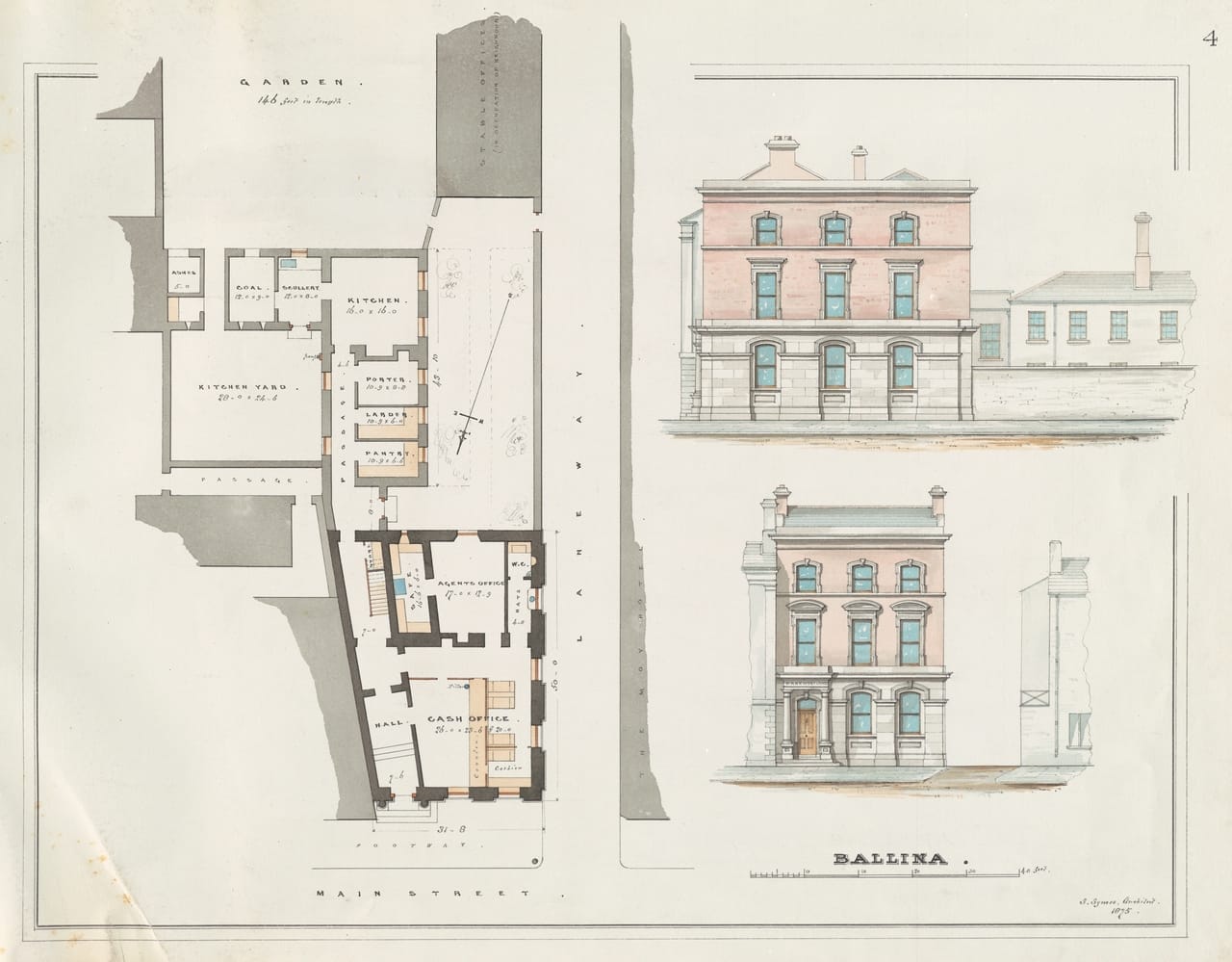
Survey of the Bank of Ireland, Ballina, Co. Mayo

Sandham Symes

1879

Ink and colour wash on paper

IAA 2006/65 Bank of Ireland Drawings Collection Album 1, No. 4

Building for Commerce


Survey of the Bank of Ireland, Ballina, Co. Mayo

Sandham Symes

1879

Ink and colour wash on paper

IAA 2006/65 Bank of Ireland Drawings Collection Album 1, No. 4

This ground floor plan, accompanied by front and side elevations, details the Bank of Ireland premises at Knox Street (now Pearse Street), Ballina, Co. Mayo. It comes from an album of survey drawings of the Bank’s branches ‘as they existed in January 1879’ prepared by Sandham Symes, architect to the Bank from 1854 to 1879. Established in 1782 by Grattan’s Parliament on foot of decades of instability among private Irish banks, the Bank of Ireland opened its first branch in Mary’s Abbey, Dublin, in 1783. It purchased the former Parliament Building in College Green, Dublin, in 1803 and by 1827 had expanded to Cork, Waterford, Clonmel, Newry, Belfast, Londonderry and Westport. Fifty years later, as recorded by Symes, it had reached fifty-nine locations, from Armagh to Skibbereen.

Some of the branches recorded by Symes were adaptations of existing buildings – houses or commercial premises – while others, including Ballina, were specifically designed and built for the Bank. Many of the alterations, and most of the new buildings, were designed by Symes himself. This includes Ballina, one of his last new projects before retirement. Common to all the buildings were elements which allowed them to function as banks, in particular a public cash office, an ‘Agent’s Office’, and a safe. It is clear too from the survey plans that each of the buildings also functioned as a house, providing accommodation for the Bank’s Agent (the local manager), or a clerk, or a caretaker. Kitchens, parlours, and related facilities including sculleries or servant’s rooms, were generally located at ground floor level, with yards, gardens, stables and coach houses to the rear. Living rooms and bedrooms located on upper floors were not included in Symes’s surveys.

Several of the buildings recorded by Symes no longer exist while others have been altered. Some no longer function as banks but others, again including Ballina, continue to serve as Bank of Ireland branches, at least for now.
Black and white photograph of a market in Dungarvan, Co. Waterford in the 1880s.
13.1 Market day, Dungarvan, Co. Waterford (IAA Photo Collection 23/48 V5)

Trade and the Irish town

 Orla Murphy

In An Irish Journey, Seán Ó Faoláin described Ballina in 1940 as a ‘a fine, healthy, graceless town, much interested in sport and as raw as the land around it’ and further remarked on a hen that ‘walked sedately across the main street’.(1) The image of a street that was quiet enough for poultry to perambulate paints a picture of the rural Irish town before the advent of vehicular traffic and closely connected to its agricultural context.

Throughout history, rural towns in their many and varied forms centred on the exchange of goods and services with their hinterlands.(2) From the middle ages feudal grants to Anglo-Norman settlers bound together defence, labour and trade, which resulted in the building of organised walled market towns.(3) Political control went hand in hand with trade in the establishment of Tudor Plantation and later planned Estate towns. Market places and main streets were the site of both permanent and temporary trade: the street edges occupied with shops and industry, the open spaces accommodating transitory fair days and markets, their fortunes fluctuating in response to political, societal and cultural changes (13.1).

Travel writers in the nineteenth and early twentieth centuries often remarked on co-existing prosperity and degradation as the economic circumstances of some improved while others struggled in poverty. Henry D. Inglis in his book A Journey throughout Ireland, during the Spring, Summer and Autumn of 1834, tells us that ‘Ballina […] has one excellent street, the greater part of which is nearly new, and which contains many good houses, and shops which would be creditable to any town’.(4) Writing just a few years before the worst impacts of the Famine, Inglis finds both extreme poverty and hardship alongside burgeoning trade and commerce in towns. J. M. Synge, in 1911, writes of the small town in Mayo that ‘nearly all towns of this class are merely trading centres kept up by the country people that live around them […] where the streets look empty and miserable till a market day arrives’.(5) Remote from the innovation that accompanied the Industrial Revolution and enduring the long shadow of the Famine and subsequent emigration, many towns in the west of Ireland struggled throughout the mid nineteenth century, while the country as a whole experienced fluctuating economic expansion and contraction.

One indicator of economic progress was the presence of a bank. Economic historian Cormac Ó Gráda notes that between 1825 and 1845 banking in Ireland became more formalised and competitive after the passing of the Irish Bank Act of 1824, with the Provincial, the Hibernian and the National setting up joint stock banks throughout the country.(6) The total number of bank branches or agencies rose from fourteen in 1825 to fifty-four in 1834 and to 173 in 1845.(7) Ó Gráda notes that the new banks in rural towns ‘mopped up money that had previously been hoarded’.(8)

In Ballina the succession of bank buildings is indicative of this changing fiscal landscape. The first bank to establish a branch in the town was the Provincial, which opened in 1828 on Knox Street (now Pearse Street), just three years after its first branch opened in Cork. By 1845, the Provincial Bank had thirty-seven branches in Ireland.(9) It gained an impressive new home in Ballina in a red brick building designed by Thomas Manly Deane in 1881 (currently home to the Jackie Clarke Collection). In 1845 the National Bank also opened a branch on Knox Street. This was followed by the Ulster Bank in 1874 and one year later the Bank of Ireland established its branch in the town, also on Knox Street and designed by Sandham Symes. In 1966 the National Bank amalgamated with the Munster and Leinster and the Royal Bank of Ireland to form Allied Irish Banks. The AIB occupied the former site of the Munster and Leinster on Pearse Street in 1977 and is still there today, across the street from the original Bank of Ireland building. According to Terry Reilly, two other banks – the Agricultural and Commercial Bank, and the Cork and Limerick Savings Bank – also had branches in Ballina.(10)

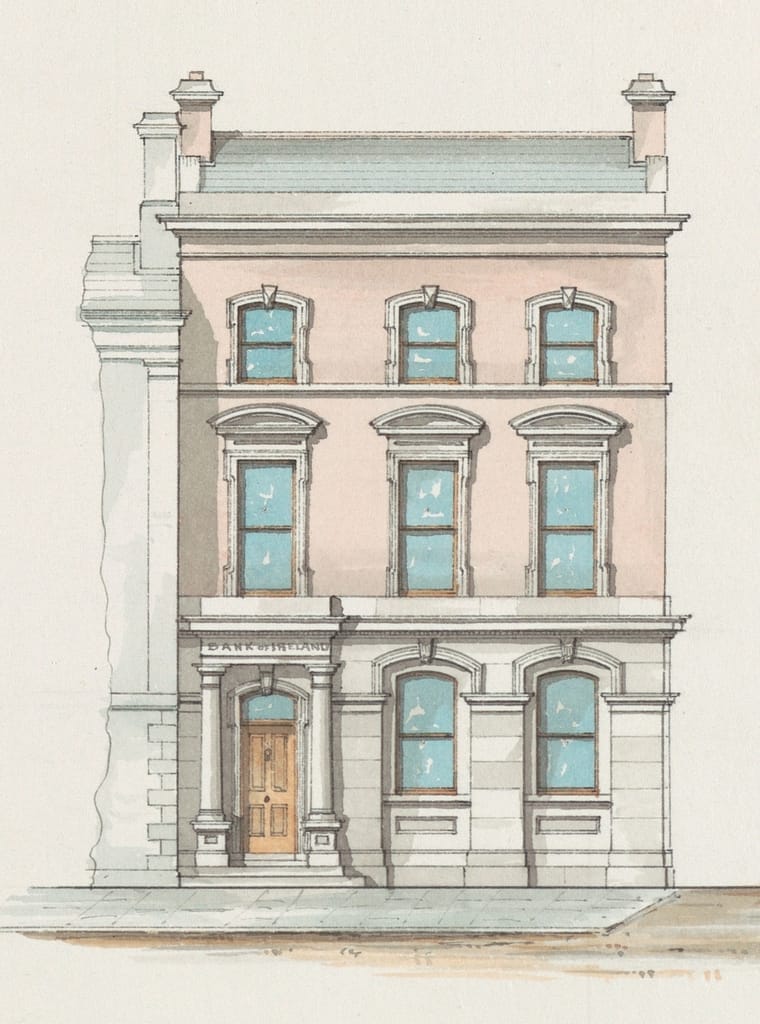
Front elevation drawing by Sandham Symes of the Bank of Ireland, Ballina, Co. Mayo, 1879.
13.2 Sandham Symes, Survey of Bank of Ireland, Ballina, Co. Mayo, 1879 (IAA Bank of Ireland Drawings Collection 2006/65 Album 1, No. 4). Detail

In Ballina the succession of bank buildings is indicative of this changing fiscal landscape. The first bank to establish a branch in the town was the Provincial, which opened in 1828 on Knox Street (now Pearse Street), just three years after its first branch opened in Cork. By 1845, the Provincial Bank had thirty-seven branches in Ireland.(9) It gained an impressive new home in Ballina in a red brick building designed by Thomas Manly Deane in 1881 (currently home to the Jackie Clarke Collection). In 1845 the National Bank also opened a branch on Knox Street. This was followed by the Ulster Bank in 1874 and one year later the Bank of Ireland established its branch in the town, also on Knox Street and designed by Sandham Symes. In 1966 the National Bank amalgamated with the Munster and Leinster and the Royal Bank of Ireland to form Allied Irish Banks. The AIB occupied the former site of the Munster and Leinster on Pearse Street in 1977 and is still there today, across the street from the original Bank of Ireland building. According to Terry Reilly, two other banks – the Agricultural and Commercial Bank, and the Cork and Limerick Savings Bank – also had branches in Ballina.(10)

The Bank of Ireland commands a presence on Pearse Street today, no doubt as it also did when it was first built (13.2). It achieves this by its use of three design devices. In scale, its three storeys rise over forty feet, with a first floor piano nobile of over fourteen feet. The front wall is recessed from the line of the street. The ground floor level is raised three steps higher than the street level, and the granite steps to the entrance are accommodated in the depth of the set-back. The language of the building is strong, simple, elegant, proportional. It conveys quality, attention to detail and care. There is nothing excessive, fussy, ornamental or unnecessary in the language of the architecture. A photograph of Knox Street in the National Library’s Lawrence Collection shows the Bank of Ireland in its street context (13.3). Set back from the main line of the street, taller than its neighbours (many of which are also three storeys) the building is authoritative in its height and scale, but its recessed façade and classical proportions communicate a resolute support for the life, trade and business of the town.

Black and white photograph taken by Robert French showing Knox Street (now Pearse Street), Ballina, Co. Mayo, circa 1880.
13.3 Robert French, Knox Street (now Pearse Street), Ballina, Co. Mayo, c. 1880 (Lawrence Collection NLI, L_ROY_07399)

Symes’s survey drawing of the Knox Street Bank of Ireland is from an album of similar drawings by him in the IAA’s collection. While each design is different, they share a broadly similar architectural language of solid, unfussy, classical proportions, layout and expression (13.4 and 13.5). A bank needs to convey trust, wealth, security and longevity and Symes uses the devices above to communicate this in his designs for the Bank of Ireland.

While the other banks on Pearse Street came and went, only this building has continued to house its original function since the nineteenth century. It stands as a witness to the trade and commerce of a country town, with its shops, offices, hotels, police barracks, convent, small businesses and, while far fewer today, the dwellings that occupied the upper floors and curtilages.

Survey drawing by Sandham Symes of the Bank of Ireland, Listowel, Co. Kerry, 1879.
13.4 Sandham Symes, Survey of Bank of Ireland, Listowel, Co. Kerry, 1879 (IAA Bank of Ireland Drawings Collection 2006/65 Album 1, No. 25)
Survey drawing by Sandham Symes of the Bank of Ireland, Donegall Place, Belfast, 1879.
13.5 Sandham Symes, Survey of Bank of Ireland, Donegall Place, Belfast, 1879 (IAA Bank of Ireland Drawings Collection 2006/65 Album 1, No. 7)

Pearse Street in Ballina is unique, but in many ways also typical of the main streets of many rural towns. On a busy Friday afternoon in August 2025, it hums with life. The Bank of Ireland’s presence on the street still conveys stability, a testament to the quality of materials and construction designed by Symes (13.6). While many streets in rural towns face challenges of decay and dereliction there are also signs of investment and care in the public realm of many main streets, including Pearse Street. The street is a backdrop to the daily ebb and flow of life. People sit alone or in small groups taking in the sunshine, others meander without hurried purpose glancing into the shop windows, others still move briskly with intent.

As places of commerce, the streets of Irish towns constantly change. They have seen political upheavals and peace, economic recession and recovery. Their resilience, as demonstrated by the Bank of Ireland building, is steadfast and on this summer day it gleams in the sunshine as if to say, this is a good place to be.


Footnotes:

1  Seán Ó Faoláin, An Irish Journey (London, 1940), 211.

2  Kevin Whelan in F. H. A. Aalen, Kevin Whelan and Matthew Stout eds, Atlas of the Rural Irish Landscape (Cork, 2011), 256.

3  For discussion of feudalism and its link to trade and commerce in medieval Ireland see Brian Graham in Terry Barry ed., A History of Settlement in Ireland (London, 2012), 124-137.

4  Henry D. Inglis, A Journey throughout Ireland during the Spring, Summer and Autumn of 1834 (London, 1835), 265.

5  J. M. Synge, Travels in Wicklow, West Kerry and Connemara (reprint London, 2009), 207.

6  Cormac Ó Gráda, Ireland: A New Economic History, 1780-1939 (Oxford, 1995), 139.

7  Ó Gráda, Ireland, 140.

8  ibid.

9  Michael O’Neill, Bank Architecture in Dublin, A History to c.1940 (Dublin, 2011), 14.

10  Terry Reilly, Dear Old Ballina (Ballina, 1993), 400.


Orla Murphy is an architect and Assistant Professor and Deputy Co-Head of the School of Architecture Planning and Environmental Policy, University College Dublin. She is founding Co-Director of the UCD Centre for Irish Towns and owner of Custom Architecture.


Colour photograph of the Bank of Ireland, Pearse Street, Ballina, Co. Mayo, taken in August 2025 by Oral Murphy.
13.6 Bank of Ireland, Pearse Street, Ballina, Co. Mayo, August 2025 (Oral Murphy)

Back to main Pivot Points page.

Donate

Large or small, every donation helps secure the future of the collection. We are truly grateful for your support.

Donate now

Donate

Large or small, every donation helps secure the future of the collection. We are truly grateful for your support.

Donate now

Follow us

  • Facebook
  • Instagram
  • Linkedin

Address

45 Merrion Sq.
Dublin 2
D02 VY60

Contact

01 663 3040
info@irisharchitecturalarchive.ie

English | As Gaeilge

  • English

Opening Hours

Reading Room

10am-5pm, Tuesdays to Fridays; Mondays by appointment

Exhibitions

10am-5pm, Mondays to Fridays

Newsletter

Stay in touch, receive updates about exhibitions and events

Subscribe

English | As Gaeilge

Menu
  • Catalogue
  • Dictionary of Irish Architects
  • About Us
    • About
    • Board
    • Members
    • Staff
    • Annual Reports
    • Contact
  • Our Collections
    • Collections
    • Online Catalogue
  • Our Exhibitions
    • Current Exhibitions
    • Past Exhibitions
  • Our Building
    • No. 45 Merrion Square
    • Venue Hire
  • Access
    • Visit
    • Reading Room
  • Support us
    • Donate
    • Major Sponsors
Search this site

Subscribe

* indicates required

The Irish Architectural Archive will use the information you provide on this form to send you its regular Newsletter. Please confirm that you would like to hear from us:

You can change your mind at any time by clicking the unsubscribe link in the footer of any email you receive from us, or by contacting us at info@iarc.ie. We will treat your information with respect. By clicking below, you agree that we may process your information in accordance with these terms.

We use Mailchimp as our marketing platform. By clicking below to subscribe, you acknowledge that your information will be transferred to Mailchimp for processing. Learn more about Mailchimp's privacy practices.

  • English