A Church for The Liberator
Niamh NicGhabhann Coleman
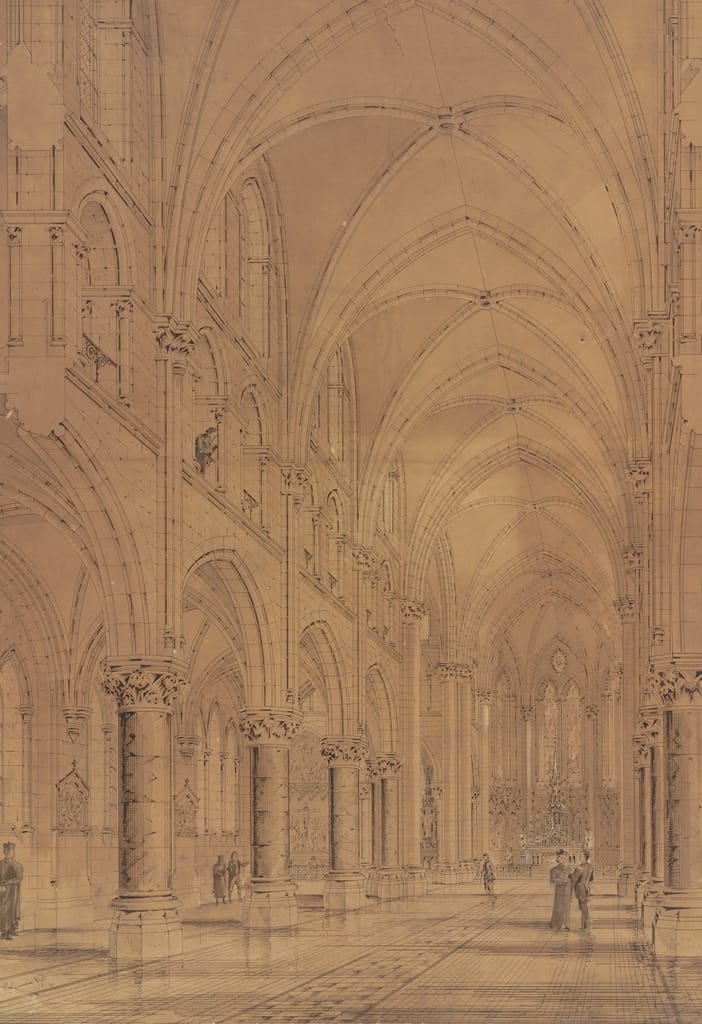
Thomas Aloysius Coleman’s 1884 drawing of the planned O’Connell Memorial Church in Cahirciveen, Co. Kerry, presents a calm, magnificent interior. The imposing columns of the nave arcade have elegant foliate capitals, and well-dressed members of the laity and clergy glide across the polished floor. The sanctuary hosts an elaborate marble altar, and, to the left, a woman kneels before a large painted altarpiece in a side chapel. Despite being a monochrome image, the drawing conjures up a richly coloured interior in the mind’s eye, suggesting stained glass, ecclesiastical paintings, and polychrome surfaces. Canon Timothy Brosnan first suggested the idea for the church as an appropriate tribute to ‘The Liberator’ in a letter to the Freeman’s Journal on 25 July 1882. The foundation stone of the new building was laid by Archbishop Thomas Croke on 1 August 1888, and, after a protracted fundraising campaign and a long building process, the first Mass was held in the building in 1902. The church was designed by George Coppinger Ashlin, one of the most prolific ecclesiastical architects of the later nineteenth century, whose recent works had included St Colman’s Cathedral in Queenstown, now Cobh, Co. Cork.
Coleman’s drawing of the interior was reproduced in a promotional booklet for the O’Connell Memorial Church project, probably printed in order to aid the extensive national and international fundraising appeals the project required. The booklet included a further perspectival drawing of the church exterior, with its soaring tower and spire set against the picturesque Kerry coastline (14.1). Two copies of this booklet are held in the Irish Architectural Archive and both have the words ‘red sandstone from the Minard quarry near Dingle’ crossed out, with ‘Co. Dublin granite’ hand-written in the margin.(1) In the end, the stone for the church came from Newry. The stone for the nave columns came from the Castlewellan quarries in Co. Down.(2) Valentia slate and Irish oak were used in the roof. These details were carefully outlined in newspaper reports on the church’s progress, highlighting the stimulus that such projects gave to local industry and employment in order to counteract criticisms of the Catholic clergy as extractive and self-aggrandizing in their promotion of such magnificent buildings at a time of economic hardship.
In his description of the proposed building, Ashlin noted that it would be ‘the first new church erected in Ireland since the Reformation with a stone-groined ceiling’. ‘The remote position of the new church’, Ashlin was reported as saying, ‘rendered it desirable to make it as enduring and as storm-proof as possible’. Furthermore, ‘there is nothing which imparts so monumental a character as a stone-groined ceiling, requiring massive walls and buttresses to support it’.(3) This emphasis on the monumental character of the new building reflects a prevailing concern in the design and construction of Catholic churches from the middle of the nineteenth century onwards. The history of Catholic architecture in Ireland is, in many ways, a history of rebuilding. Between the 1750s and the 1900s, a church could be rebuilt several times. In Carrick-on-Suir, Co. Tipperary, for example, the existing chapel was rebuilt in 1807-9, only to be demolished and replaced with a new church in the 1880s. The O’Connell Memorial Church was built to replace an existing chapel, noted in Samuel Lewis’s 1837 Topographical Dictionary. This earlier chapel is depicted on the first six-inch Ordnance Survey map as a quite substantial cruciform building. While it was described by Lewis as a ‘handsome building’,(4) it had fallen into disrepair by the 1880s. This added to the rationale for the construction of the new O’Connell Memorial Church. Surviving buildings from this transitional period which may give us a sense of its original appearance include the chapel of Moycarkey in Co. Tipperary (1793), the chapel (now community centre) in Charleville, Co. Cork (1812), or the chapel in Tinryland in Carlow (1819) (14.2). Lewis used the descriptor ‘handsome’ quite liberally, but it tends to correspond with cruciform buildings which have cut-stone elements on the exterior, and decorative plasterwork on the interior.